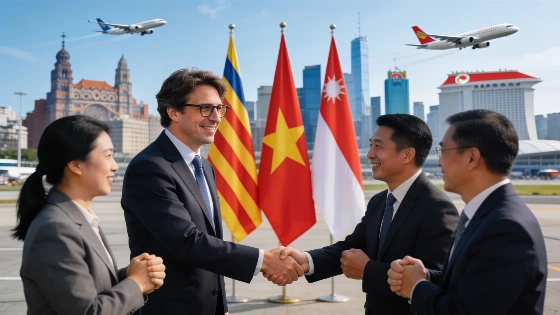
Catalonia's president, Salvador Illa, begins a six-day visit to Vietnam and Singapore. The trip aims to boost exports, attract Asian investment, and strengthen air links. Meetings with top officials and business leaders are planned.
Salvador Illa, president of the Generalitat, is set to embark on a six-day official visit to Vietnam and Singapore, starting this Saturday. The mission is designed to open new markets for Catalan companies and attract investment from Southeast Asia, a region with growing economic influence and technological potential. Illa’s agenda includes high-level meetings with government officials, business leaders, and representatives from the leading airlines of both countries, aiming to improve air connectivity between Catalonia and the region.
The trip begins in Hanoi, where Illa will meet with Vietnam’s vice prime minister, Pham Gia Tuc, to discuss economic cooperation and opportunities for Catalan businesses. The itinerary also covers visits to Da Nang, a key technology hub, and Ho Chi Minh City, Vietnam’s economic capital. In Ho Chi Minh, Illa will inaugurate a business forum focused on expanding Catalan presence in the Vietnamese market. The Catalan delegation will also engage with local and international companies already operating in the area.
Midweek, Illa will travel to Singapore, recognized as a major financial and logistics center in Asia. There, he is scheduled to meet with Singapore’s prime minister, Lawrence Wong, and hold discussions with senior Catalan executives working in multinational firms. The Generalitat aims to establish a long-term partnership with Singapore, focusing on innovation and industrial cooperation, and positioning the city-state as a strategic gateway for Catalonia in Southeast Asia.
According to sources from the Catalan government, the visit is part of a broader strategy to diversify export markets, promote the internationalization of Catalan companies, and present Catalonia as an attractive destination for foreign investment. The region is particularly interested in leveraging the rapid growth and dynamic markets of Vietnam and Singapore, both of which play significant roles in controlling key maritime routes in the region.
This marks Illa’s third institutional trip to Asia, following previous visits to Japan, South Korea, and China in 2025, as outlined in the government’s Asia Strategy for 2025–2030. The focus on Southeast Asia reflects a shift in Catalonia’s international economic policy, seeking to reduce reliance on traditional European partners and tap into emerging markets with high growth potential.
Efforts to strengthen international ties are not limited to Asia. Recent initiatives in Spain’s coastal regions, such as the adaptation of supermarket hours in tourist areas, also highlight the country’s responsiveness to changing market dynamics. For example, dozens of Mercadona stores in Valencia, Alicante, and Castellón have adjusted their Sunday opening times to better serve seasonal demand, as detailed in this report on supermarket operations in tourist zones.
Vietnam and Singapore have become increasingly important for European exporters in recent years. Vietnam’s economy has consistently posted strong growth, driven by manufacturing and technology sectors, while Singapore remains a global leader in finance, logistics, and innovation. Both countries are members of major regional trade agreements, offering Catalan businesses access to broader Asian markets. The Catalan government’s push to establish direct air links and business forums in these countries is expected to facilitate smoother trade flows and encourage more companies to explore opportunities in Southeast Asia. As global economic patterns shift, such initiatives may help Catalonia secure a stronger foothold in one of the world’s most dynamic regions.