Pedro Sánchez is calling for global rules to protect children from the risks of artificial intelligence. Spain supports a 16-year social media age limit as international groups warn about the rapid spread of AI-generated abuse material.
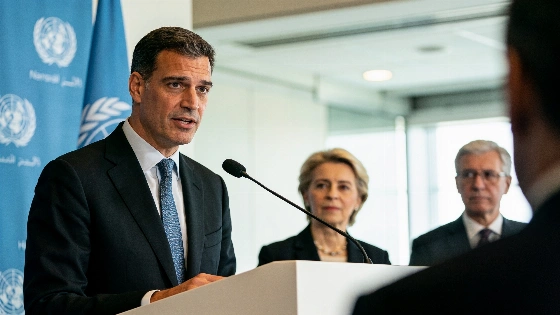
Artificial intelligence-generated child sexual abuse material rose from about 5,000 detected cases in 2023 to 1.3 million in 2025, according to figures cited by Pedro Sánchez. The Spanish prime minister used the increase to call for firm national, European and global limits on technology reaching children faster than safeguards can keep up.
He made the appeal during a high-level dialogue on protecting children's rights in the age of artificial intelligence. The figures came from Sánchez's speech. No separate public report identified in the available material independently verifies the full rise from 5,000 to 1.3 million cases.
Sánchez said companies cannot put commercial interests ahead of children's safety and mental health. His message was direct. Businesses developing these systems must answer for their effects on children instead of leaving families and society to deal with the costs of cyberbullying, hate, sexual crime, privacy loss, anxiety and loneliness.
The coalition for children’s rights and protection in the age of AI was initiated by France, Spain and Kenya on July 7, 2026. By September 22, it had expanded to 23 states and eight United Nations entities, according to the Élysée Palace.
The warning comes as children spend large amounts of time online. European minors spend up to six hours a day in front of a screen. One in three adolescents says they regularly encounter inappropriate content.
Sánchez also referred to the latest OECD PISA report. It found a general decline in educational performance, which he linked in part to artificial intelligence use. The PISA 2025 findings cited in the available research also connect frequent AI use for schoolwork with lower results than more moderate use. That link is correlational. It does not show that AI alone caused the decline.
The concern extends beyond children's habits and school results. Sánchez described a digital environment without rules as a lawless jungle. He also pointed to the concentration of wealth and influence among a small group of technology oligarchs.
In his account, these companies do more than build tools. They shape values and preferences while controlling systems whose risks are already being acknowledged by people developing advanced artificial intelligence.
Spain is taking part in the regulatory response. The government has co-led the United Nations Coalition for the Rights and Protection of Children in the Age of Artificial Intelligence.
Sánchez said the coalition was one of the first practical results of the United Nations dialogue on AI governance. That dialogue was approved the previous year, when the International Panel of Experts on Artificial Intelligence was launched.
The coalition’s roadmap identifies safety and privacy by design, benchmarking and accountability, AI-generated child sexual abuse material, deepfakes and AI literacy as practical areas for cooperation. Its roadmap was launched in New York on September 22, 2026, placing Sánchez’s appeal within an established international work programme rather than leaving it as a standalone political statement.
In Spain, the government has promoted a law that would set 16 as the minimum age for access to social networks. Parental controls would be activated by default.
The proposal was partly inspired by France and Australia. Its status is still that of a legislative proposal, not a completed rule.
At European level, Sánchez credited the European Commission with securing provisions in the European Union Artificial Intelligence Act. Those provisions prohibit non-consensual sexual deepfakes and AI-generated child sexual abuse material.
Spain has also been among the first countries to develop an age-verification system based on the European Digital Identity Wallet.
The coalition's call for common rules fits into a wider Spanish political argument about how rights are protected and enforced. It comes alongside an earlier citizenship dispute involving suspended instructions and CERA registration.
The subject is different, but the institutional challenge is similar: turning political commitments into rules that can work beyond one government or platform.
Sánchez's position leaves little room for voluntary promises from the technology industry. He is calling for cooperation between governments, international organisations, companies, educators and families. He also insists that artificial intelligence must serve humanity rather than dictate its terms.
That is the test now facing the coalition. It must turn concern about rapidly expanding harm into protections that can be enforced. Without limits, accountability and shared standards, the technology's promised benefits could remain weaker than the damage unchecked use may impose on children who are least able to defend themselves.