Pedro Sánchez presents Spain as a multilateral power at the UN, pointing to stronger growth and social protection. He also acknowledges the housing crisis and calls for tougher international rules on artificial intelligence.
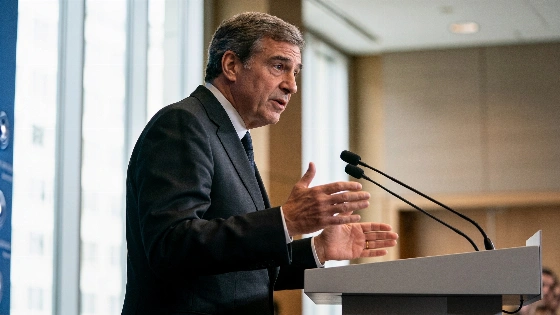
Pedro Sánchez used Spain's week at the United Nations to defend a growth model built around economic expansion and social protection. The government says Standard & Poor's has raised its forecast for Spain's 2026 growth to 2.4%, almost triple the projected pace for the eurozone. As reported by Demócrata, the revision gives Sánchez a strong argument abroad. His speech also acknowledged the pressure caused by the housing crisis at home.
That contrast sits at the centre of Spain's message in New York. The country wants to be seen as economically successful while admitting that growth has not solved the right to housing. Sánchez connected stronger employment and better wages with lower inequality under the coalition government. He then identified housing as the area where much more work is needed.
The international coalition on children’s rights and protection in the age of AI was launched on 7 July 2026 at the first UN Global Dialogue on AI Governance. By September, its roadmap had the support of 23 states and eight UN-system entities.
Sánchez placed that domestic argument within a wider defence of multilateralism. In his account of the UN week, confrontation should be met with cooperation, retreat with dialogue, and division with respect for international law, human rights and equality. He said the United Nations must become more representative and better reflect the 21st century. It should not remain shaped by the balance of the 20th.
That position came with a specific technology agenda. Spain joined France, Kenya and Australia in convening the Coalition for the Protection of Children in Artificial Intelligence. The goal is to create global measures to protect children. Sánchez said private companies matter but cannot act alone. He backed regulation at national, European and multilateral levels. The focus follows earlier AI coverage of his push for international safeguards. The Élysée says the coalition's roadmap covers safety and privacy by design, benchmarking, accountability, AI-generated child sexual abuse material, deepfakes and AI literacy.
He also presented the 2030 Agenda as a programme for ordinary people, rather than one limited to governments and international institutions. Sánchez said he had taken part in a dialogue involving advocates of the Sustainable Development Goals. He described his role as co-chair alongside the prime minister of Barbados.
The UN confirmed that the New York dialogue on children’s rights in the age of AI brought together the leaders of France, Spain, Kenya and Australia during the 81st session of the General Assembly. Australia separately described the meeting as a joint effort to advance the global coalition, underlining its multilateral character.
Gender equality was another part of the diplomatic message. Sánchez backed the idea that a Latin American woman should lead the United Nations Secretariat-General for the first time in the organisation's 80-year history. He also attended a tribute to Gloria Steinem. Equality between men and women, he said, belongs within the wider framework of human rights.
Economic promotion ran alongside the diplomatic work. At meetings with international investors and the US-Spain Chamber of Commerce, Sánchez presented Spain as stable and attractive for productive investment and job creation. He also pointed to the country's energy transition. That included a cooperation agreement with the State of California on climate action and clean energy, as well as a new alliance with Bloomberg Philanthropies to support clean-energy and grid projects.
The president's programme in the United States will continue in Boston. He is due to meet the governor of Massachusetts and hold a working agenda at Harvard University. His New York appearance also included meetings with heads of state and prime ministers. The press conference covered housing, evictions, migration policy, relations with Morocco and confidence in former prime minister Zapatero, without providing further details in the supplied transcript.
Sánchez's presentation works politically because it joins a concrete growth forecast with the government's preferred language of cohesion, climate action and rights. The housing reference keeps the economic message from becoming a simple success story. The government is claiming stronger growth while recognising a problem that affects daily life in Spain. The S&P assessment also comes with warnings about inflation and long-term interest rates, according to reporting on the agency's outlook. The UN week left Spain with two clear faces: confident abroad and still under pressure at home. The 2.4% forecast supports the first claim, while housing keeps the second in view.