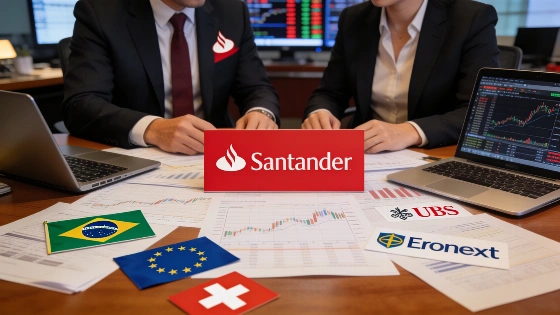
Santander will pay UBS €1.5 million to value its Brazilian subsidiary as the Spanish parent pursues a €1.9 billion takeover bid. The assignment gives the Swiss bank a prominent role in a major corporate deal after years of reduced business ties. It also brings the failed appointment of Andrea Orcel back into focus.
UBS BB Corretora prepared the independent valuation report needed to formalise Santander's offer for the 10% of Santander Brasil that the Spanish group does not control. Santander issued the mandate on September 12 and received the report last Friday. The fee is not tied to the offer's success. Santander will also reimburse UBS for expenses incurred during the work. Santander Brasil disclosed the appraisal report through the CVM/B3 system and on its investor-relations page.
Under the disclosed exchange terms, holders of ordinary Santander Brasil shares are being offered 0.2028 Santander shares for each share in the Brazilian subsidiary. ADS holders are being offered 0.4056 Santander shares for each ADS.
The arrangement raises a specific independence issue. One UBS banker who helped prepare the report currently holds options over Santander shares and shares in the Brazilian subsidiary. Those options stem from a previous employment relationship with Santander Brasil. UBS concluded that the situation did not compromise the report's independence.
The Swiss group controls UBS BB through a 50.01% stake. UBS BB has not received fees from Santander or its Brazilian subsidiary for advisory or valuation work, including audits and similar services, during the past two years. UBS Group received $1.9 million from Santander during that period for such assignments. It is also entitled to another $2.5 million for services unrelated to the Brazilian offer.
Bank of America has also been appointed as a financial adviser on the transaction. UBS so has a supporting role, unlike the leading position it once held in Santander's corporate deals. The appointments show that Santander has assembled a larger financial-advisory team for the transaction.
In documents filed on September 21, 2026, Santander reported that regulatory procedures had begun in Brazil and the United States. In the US, the bank filed Form F-4, but the regulator had not yet declared the document effective. The offer terms remained preliminary.
The current mandate is modest compared with UBS's former business with the Spanish bank. Between 2012 and 2019, when Orcel was linked to UBS, the Swiss firm advised Santander on all of its major transactions. It worked on Santander's first takeover bid for the Brazilian subsidiary in 2014, worth €4.7 billion. Later, it advised on the €7.5 billion capital increase in 2015 and the €7 billion operation to buy Popular in 2017.
That period ended with Orcel's failed appointment as Santander's chief executive in 2019. The two institutions then took different positions. Santander reduced its business with UBS, though the banks maintained some links, mainly in debt issuance.
The difference with other advisers is now measurable. During the same 24-month period, UBS received no comparable fees from Santander or its Brazilian subsidiary for advisory or valuation work, including audits and similar services. JPMorgan received €45 million from Santander.
The wider banking market is changing how financial services reach customers, as Santander's current exchange offer illustrates. SEC materials and disclosures made by Santander Brasil through CVM/B3 show that the transaction is structured as a share exchange rather than a cash purchase. It is valued at approximately €1.9 billion. Filings and market reports say the terms may still change after regulatory comments.