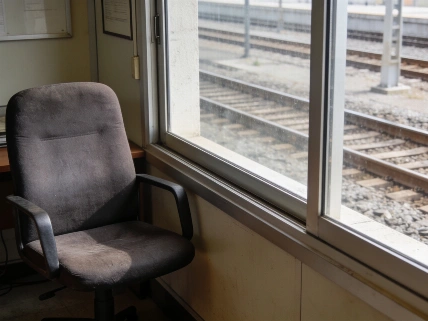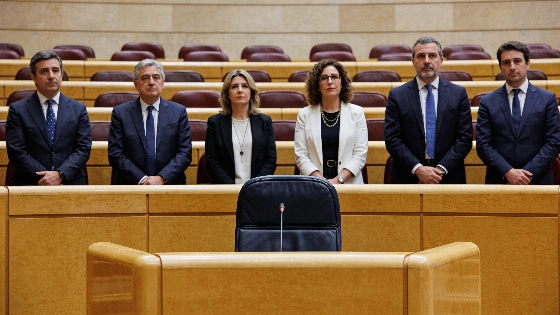
Interior Minister Fernando Grande-Marlaska’s absence from the Senate’s Interior Commission session on the Ceuta crisis sharpened tensions between the government and the Partido Popular (PP). On Wednesday, PP senators gathered in the Clara Campoamor room, leaving Marlaska’s designated seat empty and in full view. They posed for a group photo with the empty chair, a pointed display of the party’s frustration after days of conflict over ministers’ appearances in the Senate, where the PP holds an absolute majority.
Marlaska skipped the session, despite being summoned to address the situation in Ceuta. He cited his commitment to oversee the special civil protection operation for the solar eclipse in Madrid. He said he would address Ceuta in Congress at the end of the month, a justification the PP rejected. Only representatives of the PP, Vox and Junts were present when the session began at 11:00. Commission president Fernando Martínez-Maíllo, of the PP, condemned the minister’s absence as a breach of constitutional and legal duty, calling it a deliberate act of disobedience. He said the party would pursue political and legal measures to hold Marlaska accountable for failing to appear.
PP advisers were examining possible legal routes, including raising a conflict of competences before Spain’s Constitutional Court, the party said. The extraordinary session lasted about 40 minutes. PP, Vox and Junts representatives criticized the government and put forward questions they said they would have asked Marlaska. Cristina Díaz, the PP senator for Ceuta, called the situation in the city urgent and criticized the government’s slow response. Her remarks brought the dispute’s local impact into the chamber.
Vox senator Ángel Pelayo Gordillo repeated his party’s claim that Ceuta was in chaos and announced a new request for Marlaska to appear. He accused the government of disrespect and warned of a drift toward authoritarianism. The PP agreed to resubmit its demand for the minister to appear in the Senate. Junts senator Eduard Pujol criticized both major parties and renewed calls to transfer immigration powers to Catalonia, while distancing his party from the Ceuta debate.
The session ended with thanks to Senate staff who cut short their holidays to attend the extraordinary meeting. The PP and Vox briefly acknowledged recent earthquake victims, but deaths at the Ceuta border received little attention. The PP expected other ministers due to appear in the coming days might also be absent, raising the prospect of more empty-chair protests. The standoff has sharpened the dispute between the Senate majority and the government over parliamentary accountability and ministers’ duty to appear.
Ceuta, a Spanish autonomous city on the North African coast, has faced repeated migration pressures that have fueled political disputes in Madrid. Later developments kept the issue in the spotlight: Reuters reported on 19 October 2026 that authorities had received up to 1,200 asylum applications and resolved 700 as Spain accelerated processing and returns amid rights concerns. Grande-Marlaska described the returns as voluntary, saying, “There are no covert deportations under any circumstances.” The later dispute over migration management adds to the political pressure on the minister. The legal and political fallout from his Senate absence remains a separate question of accountability in Spain’s upper chamber.