Spain’s National Court has summoned SEPI president Belén Gualda and over 20 others as suspects. The investigation centers on alleged irregularities in state-backed company rescues during the pandemic. The case could impact oversight of public funds.
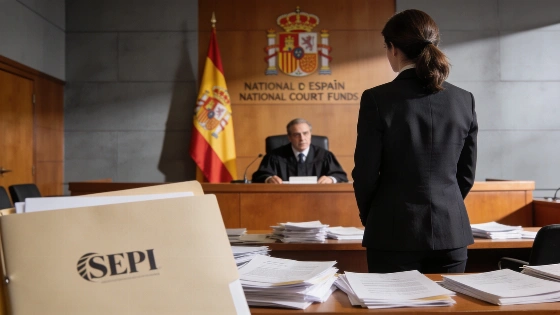
Spain’s National Court has formally summoned Belén Gualda, president of the Sociedad Estatal de Participaciones Industriales (SEPI), as an official suspect in the ongoing ‘Leire Case’ investigation. Judge Santiago Pedraz, acting on a request from the public prosecutor, has also called more than 20 other individuals to testify as part of the probe into alleged irregularities in the management of state-funded company bailouts during the COVID-19 pandemic.
The case focuses on the role of Leire Díez, described in court documents as a key intermediary with close ties to the PSOE, in facilitating the allocation of rescue funds to struggling businesses through SEPI. According to the prosecutor’s submission, there is preliminary evidence suggesting a “repeated, coordinated, and structured pattern of conduct” among those under investigation. This alleged pattern is believed to have affected multiple areas of the public sector and involved various companies and business groups.
The investigation has drawn attention due to the high-profile status of those involved and the scale of public resources at stake. The National Court’s move to summon SEPI’s top executive signals a significant escalation in the case, which has already prompted scrutiny of Spain’s mechanisms for distributing emergency financial support during the pandemic. The prosecutor’s office has emphasized that the evidence remains preliminary, but the coordinated nature of the alleged actions is central to the inquiry.
This development comes amid a broader wave of judicial scrutiny over the management of public funds during the pandemic. In a related context, the Spanish Supreme Court recently made headlines by suspending the prison sentence of Víctor de Aldama after his cooperation in the ‘caso Koldo’ corruption scandal, a decision that has fueled debate over accountability in high-profile cases. For more on the legal landscape surrounding pandemic-era investigations, see the report on the Supreme Court’s controversial ruling in the ‘caso Koldo’ here.
SEPI, as Spain’s main state industrial holding, played a central role in distributing billions of euros in aid to companies hit by the COVID-19 crisis. The ‘Leire Case’ is being closely watched for its potential to reshape oversight of public sector interventions and to clarify the boundaries of political influence in the allocation of state resources. While the investigation is still in its early stages, the outcome could have lasting implications for transparency and governance in Spain’s management of emergency funds. The National Court is expected to release further details as the inquiry progresses.