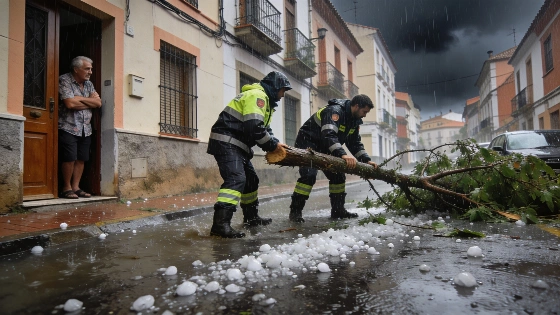
Spain’s meteorological agency has issued orange alerts for violent storms in the Mediterranean. Heavy rain, hail, and damaging winds threaten Catalonia, Valencia, Murcia, Almería, and the Balearic Islands. Authorities urge caution.
Spain's Mediterranean coast is under orange weather alerts as a strong storm front moves in, bringing flash floods, large hail, and damaging winds. The Agencia Estatal de Meteorología (Aemet) has warned that the highest risk is in Catalonia, the Balearic Islands, Comunidad Valenciana, Murcia, and Almería. Local authorities are preparing for possible disruptions and damage. According to Aemet bulletins for September 9, 2026, orange-level warnings for rain and thunderstorms cover all the Balearic Islands, Catalonia, Murcia, and the Valencian Community.
Residents in these regions woke up to warnings about sudden drops in temperature and the risk of localized flooding. The storm, driven by a sharp cold front, is expected to bring heavy downpours and hailstones large enough to damage cars and property. Strong winds could bring down trees and power lines, with the most dangerous conditions expected in the southeast and the Balearic Islands, especially overnight and into Thursday morning. On the northern coast of Alicante, rainfall could reach up to 60 liters per square meter in 12 hours and 40 liters per square meter in just one hour, with a risk of large hail and strong winds.
On the Balearic Islands, wind gusts are forecast to reach up to 90 km/h, and orange alerts for heavy rain and thunderstorms have been extended to the entire archipelago.
AEMET
Aemet spokesperson Rubén del Campo said the orange alerts are staggered: Catalonia remains under warning until 13:59, the Balearic Islands from midday, Comunidad Valenciana and Murcia from 14:00, and Almería from 16:00. Del Campo urged the public to follow Protección Civil advice and avoid unnecessary travel during the worst of the storms. In Catalonia, Protección Civil has already sent ES-ALERT messages restricting movement and activities in several comarcas, including Alt Penedès, Baix Penedès, Garraf, Baix Llobregat, and Vallès Occidental, and has suspended some urgent social and medical services.
Seven autonomous communities are under some form of weather alert. Andalucía faces both orange warnings for storms and yellow for heat, while Aragón is on yellow alert for wind. The Balearic Islands, Catalonia, Murcia, and Comunidad Valenciana all face orange-level threats for rain and storms, with additional yellow warnings for wind and rough seas. In Murcia, despite the storm risk, maximum temperatures could still reach 37°C, showing the mix of heat and instability. RTVE and local weather reports note that the front is causing a sharp drop in temperatures by about 8–12°C across eastern Spain and the Balearics, while the southeast remains unusually hot.
As the front passes, temperatures are set to fall by 8 to 12 degrees across much of eastern Spain and the Balearics, except for the far southeast where the heat lingers. Northern winds will pick up in the northeast and over the islands, adding to the risk of dangerous conditions.
In addition to the regions under orange alert, yellow warnings for wind, coastal phenomena, and heat have been issued in Andalucía and Aragón, indicating that at least 7–8 autonomous communities are affected by this multi-faceted episode of unstable weather.
Official weather bulletins
Overnight into Thursday, the southeast, Melilla, and the Balearic Islands will continue to see violent storms and strong winds, with conditions expected to ease by midday. Galicia and the Cantabrian coast will see only light rain, and the rest of the country will have clearer skies. The coldest night will be in the interior, with temperatures dropping below 10°C in many northern areas.
By Friday and into the weekend, stable, high-pressure weather is expected to return, with temperatures rising above 30°C in many regions and possibly reaching 38°C in some valleys. In the Canary Islands, after a period of intense heat, temperatures will normalize midweek before climbing again over the weekend, along with strong trade winds and occasional light rain in the north.
Spain’s Mediterranean coast has faced repeated weather extremes in recent years, from wildfires to sudden storms. As reported earlier, Valencia is still recovering from a major wildfire, showing how quickly the region can shift between drought and flooding.
These latest alerts highlight the challenge for emergency services and local governments, who must prepare for both heat and flooding in the same week. Abrupt weather swings are becoming more common in Spain, forcing authorities and residents to adapt quickly. The current episode is a reminder that Mediterranean Spain now faces not only summer heatwaves but also violent storms that can disrupt daily life and damage infrastructure. How well the country responds and coordinates across regions will shape its ability to handle these unpredictable events.