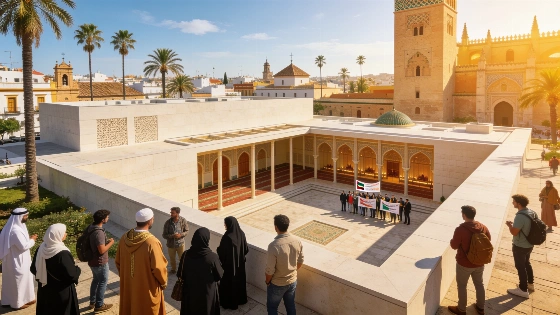
Seville’s city council has granted a construction license for a large Islamic cultural center. The decision comes despite strong opposition from Vox, which threatens to withdraw support from the local government. The project has sparked debate over religious spaces and urban planning.
The Seville City Council has officially approved the construction license for a major Islamic cultural center, commonly referred to as a mosque by its promoters. The decision, made by the council led by the Partido Popular (PP), comes after weeks of political tension and public debate, as the far-right Vox party threatened to withdraw its support from the municipal government if the project moved forward.
The project, which has been in development for over two decades, faced a temporary delay earlier in July when Vox demanded a review of the building permit. Vox argued that the center would contribute to the “islamization of Seville’s neighborhoods” and claimed the religious use was incompatible with the zoning of the site. Despite these objections, the city’s Urban Planning Department found no legal grounds to deny the license, clearing the way for construction to proceed.
The planned complex, designed by renowned Sevillian architect Guillermo Vázquez Consuegra, will occupy a 2,500-square-meter plot, with 400 square meters dedicated to a prayer hall. The remainder of the space will house facilities such as classrooms, a library, a cafeteria, exhibition areas, and spaces for business and social activities. The promoters emphasize that the center is inspired by the traditional Islamic concept of the Imaret, serving both religious and broader community functions.
Seville is home to Spain’s largest number of Catholic churches and religious events, yet its Muslim community—estimated at around 9,000 practicing members, or 1.3% of the city’s population—has long lacked a dedicated, purpose-built space for worship and cultural activities. Most existing prayer spaces are located in converted garages or commercial premises. The Foundation Mezquita de Sevilla, which leads the project, has argued that the new center will provide a dignified and inclusive venue for both religious and cultural engagement.
Vox, however, remains firmly opposed. The party’s local spokesperson has stated that supporting a government that “rolls out the red carpet” for the Foundation Mezquita de Sevilla is untenable. Vox has pledged to pursue all available legal, political, and administrative avenues to halt the project, and recently organized a small protest against the council’s decision. Despite these threats, city officials, including the mayor and the head of urban planning, maintain that the project fully complies with legal requirements and that denying the license would be unlawful.
The debate has highlighted broader questions about the coexistence of religious and cultural spaces in public facilities. Examples cited include the presence of a Catholic chapel in the Virgen del Rocío Hospital and the headquarters of the Hermandad de los Estudiantes within the University of Seville. The Foundation Mezquita de Sevilla has welcomed the council’s decision, stating that it demonstrates the primacy of law over ideology.
According to public records, the new Islamic center will be entirely privately funded. Its design aims to create an open, accessible space for all residents of Seville, described in project documents as a place for “encounter, reflection, and serenity.” Similar Islamic cultural centers already exist in other Andalusian cities such as Málaga, Córdoba, and Granada.
Spain’s legal framework guarantees freedom of religion and equal treatment for all faiths. Urban planning regulations typically allow for religious, cultural, and social uses to coexist within the same complex, provided zoning requirements are met. The approval of the Seville project may set a precedent for future religious and cultural developments in other Spanish cities, especially as demographic changes continue to shape urban life. The ongoing dispute also reflects the broader national debate over integration, identity, and the role of minority communities in public space.