Seville’s Urban Planning Authority has postponed the license for a new Islamic Cultural Center. The project, backed by private donations, faces political resistance and legal challenges. Local associations highlight the need for more public infrastructure.
The Urban Planning Authority in Seville has once again postponed the decision on granting a license for the construction of a new Islamic Cultural Center, reigniting a debate that has simmered for over twenty years. The project, designed by renowned architect Guillermo Vázquez Consuegra, was set to transform a neglected plot in the Polígono Sur district into a complex featuring a prayer hall, cultural spaces, and social facilities. However, the process has become a flashpoint for political and social tensions in the city.
The latest delay follows a formal request from Vox, which demanded a review and suspension of the license, arguing that the center represents an "islamization" of local neighborhoods. Manuel Gavira, the new vice president of Vox in the Junta de Andalucía, has announced plans to pursue all possible legal, political, and administrative avenues to halt the project. This stance has put pressure on the municipal government, led by the Partido Popular (PP) with Vox’s support, despite city officials maintaining that the project complies with all legal requirements.
Local residents’ associations in Polígono Sur have not opposed the center itself, noting that it would rehabilitate an unused and degraded area. Instead, they have used the occasion to call attention to the district’s longstanding need for public infrastructure and criticized the lack of prior communication from authorities. Jaime Bretón, commissioner for the area and former PP councilor, welcomed any initiative that brings activity to the neighborhood, reflecting a more pragmatic local perspective.
The Islamic Cultural Center has been in development since 2004, originally promoted by the city’s Islamic community under a Socialist administration. Progress stalled for years due to neighborhood pressure and municipal inaction. The current project gained momentum thanks to a fundraising campaign led by the Fundación Mezquita de Sevilla, with significant support from former Sevilla FC footballer Frédéric Oumar Kanouté. The center’s €12 million budget is entirely funded by private donations, making it the largest private investment in the district’s history and expected to generate over a thousand jobs.
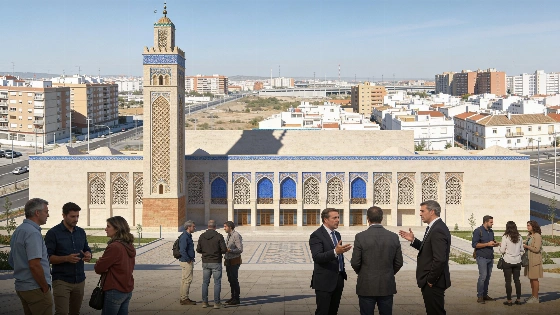
Despite the political controversy, the project has passed all technical reviews by municipal staff, according to Jalid Nieto, vice president of the Fundación Islámica. The design allocates 400 square meters of the 2,500-square-meter site to a prayer hall, with the remainder dedicated to cultural and social uses. The building will feature a minaret and Andalusian latticework reminiscent of the Giralda, Sevilla’s iconic former minaret, and the Moroccan pavilion from the Expo. The center is described as a space for reflection, community, and cultural exchange, open to all residents of Seville.
Vox, however, continues to frame the project as primarily a mosque, arguing that its cultural and social functions are secondary and not adequately reflected in the license application. This argument underpins their demand for the suspension of the approval process. The party’s leadership in both the Junta and the city council has escalated the dispute, insisting that the district’s priorities should be security, employment, and public services rather than new religious facilities.
It is notable that Seville, a city known for its Catholic heritage, already hosts around thirty Islamic prayer spaces and nearly a hundred places of worship for other religions, most of which have not generated significant controversy. Similar Islamic cultural centers exist elsewhere in Andalusia, such as the Centro Cultural Andalusí in Málaga and the Mezquita Mayor in Granada, both established in 2003. These projects have sometimes faced local resistance, particularly in areas with high tourist traffic, but have also become symbols of intercultural coexistence.
Elsewhere in Spain, cities like Córdoba have long-standing Islamic centers, including the capital’s mosque, operational since 1992, and the Pedro Abad mosque, which serves as the national headquarters for the Ahmadiyya Muslim Community. The debate in Seville echoes broader discussions about religious diversity and urban development across the country. For context, recent events in other Spanish cities, such as the emergency response to a major wildfire in Catalonia that forced lockdowns in several towns, as reported in coverage of the La Bisbal d'Empordà incident, highlight how local authorities must often balance urgent community needs with long-term planning and social cohesion.