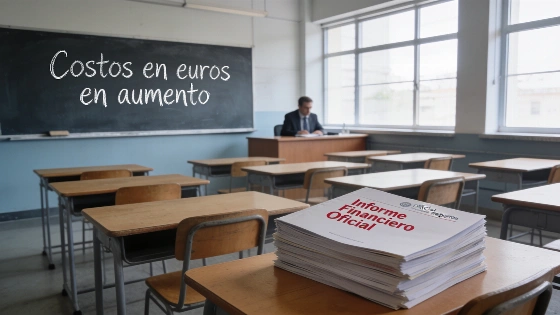
The Síndica de Greuges urges nearly €1 billion in extra funding to make schooling truly free. Despite higher budgets, families still pay significant fees. The report highlights persistent inequalities and outdated support measures.
The Síndica de Greuges has called for an urgent injection of €944 million to tackle chronic underfunding in Catalonia’s education system, warning that current spending fails to guarantee free schooling. The latest report, released this week, reveals that despite a 35% increase in public investment since 2019, the financial burden on families remains high and inequalities between schools persist.
The 266-page analysis finds that the gap between actual costs and public funding has not narrowed, largely due to inflation and a sharp rise in students with special needs. The proportion of vulnerable pupils has jumped from 6% to 30% in recent years, further straining resources. According to the report, families in public schools pay around €1,000 per year to cover what the state does not, while those in concerted (semi-private) schools face average annual costs of €3,900.
One of the report’s key criticisms is the lack of effective oversight on school fees and related charges. Some concerted schools, for example, have increased lunch prices to nearly €10 per day—compared to €7 in public schools—to offset funding gaps. The study also notes that funding and measures like class size reductions are applied uniformly, rather than tailored to each school’s needs, which can deepen disparities.
Another issue highlighted is the outdated classification of school complexity. Currently, 28% of public schools are considered highly complex, compared to just 6% of concerted schools. This affects how resources are distributed and can limit opportunities for students in more challenging environments.
The report updates the estimated cost per student place, now calculated at €6,233 for primary and €8,118 for secondary education in public schools. In concerted schools, the figures are €5,462 and €6,067, respectively. The higher costs in public schools are attributed mainly to better working conditions for teachers, including shorter teaching hours. Since 2020, these costs have risen by up to 26% in public schools and 21% in concerted schools, driven by improved teacher contracts, smaller class sizes, and more students with additional needs.
To address these challenges, the Síndica recommends increasing the so-called ‘economic backpacks’—direct financial support for families—from €385 to €457 per student in public schools, and from €988 to €1,175 in concerted schools. However, the Catalan government has so far only raised the amount for concerted schools, setting it at €1,182, and declined to increase support for public school students. The Síndica also suggests that public school support should cover extracurricular activities, potentially doubling the amount to nearly €800 per student.
The process of updating the cost estimates faced delays due to government changes, slow formation of the required commission, and internal issues at the Síndica’s office. As a result, the government announced increased support for concerted schools in March before the report was finalized. The Síndica has not commented on the timing or the government’s decision.
Spain’s education system is divided between public, concerted, and private schools, with concerted schools receiving partial state funding but often charging additional fees. The debate over funding and equity has intensified as inflation and demographic changes put pressure on school budgets. Ensuring equal access to quality education remains a central challenge, especially as the number of students with complex needs continues to grow. The Síndica’s report underscores the need for targeted investment and updated policies to prevent further widening of the gap between schools and families.