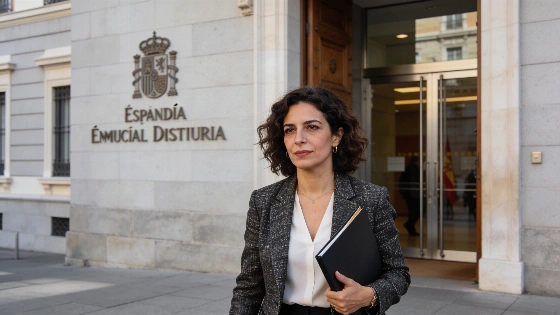
Sira Rego, Minister of Youth and Children, confirms she will not be on the left-wing coalition lists for Spain’s 2027 general elections. She urges parties to choose a candidate who unites the bloc. The decision marks a shift in the coalition’s leadership.
Sira Rego, Spain’s Minister of Youth and Children, has announced she will not be a candidate in the left-wing coalition’s lists for the 2027 general elections. The decision, which she explained in an interview with Europa Press, signals a significant change for the alliance formed by IU, Movimiento Sumar, Más Madrid, and Comuns. Rego emphasized her belief in the “collective intelligence” of these parties to select a candidate capable of generating broad consensus, expressing confidence that the eventual choice will be well-suited for the role.
Rego, who has led the Ministry of Youth and Children since its creation in November 2023, described her decision as a healthy step back after years in frontline institutional politics. She stated her intention to support future projects with her experience and knowledge, but clarified she will not seek a place on the electoral lists. Instead, she remains available to assist the emerging left-wing coalition in other capacities.
According to Rego, the left must engage in deep reflection about its future political projects, moving beyond the immediate electoral cycle. She highlighted the need to rethink forms of activism and called for a broad front among organizations to the left of PSOE, built on a “minimum program” focused on defending public services, feminism, environmentalism, and children’s rights. Rego argued that such a coalition should be led by whoever can unite the most support, and she sees agreement on programmatic issues as straightforward for the involved parties.
Her political trajectory includes serving as a Member of the European Parliament and as federal spokesperson for IU under Alberto Garzón. Rego became the party’s most visible figure after Garzón stepped down as Minister of Consumer Affairs. Born in Spain to a Palestinian family, she spent much of her childhood in Palestine, with close relatives still living in the West Bank. This personal connection has shaped her consistent advocacy for the Palestinian cause. Following the escalation of violence after the October 7 Hamas attacks, Rego has remained vocal in protests and in her condemnation of Israel, which she describes as the “occupying power.”
Rego’s withdrawal comes at a time when the Spanish left is seeking new leadership and direction. The creation of the Ministry of Youth and Children in 2023 reflected a broader trend in Spanish politics to address youth issues more directly. Her stance on international matters, particularly the Israeli-Palestinian conflict, has also distinguished her within the government. For context, Spain’s political landscape has seen other ministers take decisive positions during recent crises, as highlighted when EU ministers shifted their support for Spain after the Ceuta migrant surge, focusing attention on broader European solidarity (see analysis of EU support for Spain after Ceuta crisis).
Looking ahead, the left-wing coalition faces the challenge of selecting a new figurehead capable of uniting diverse organizations and perspectives. The process will likely test the coalition’s ability to balance programmatic unity with the need for broad appeal. Rego’s decision to step aside may open the door for new leadership, but it also underscores the importance of consensus and shared values in shaping the future of Spain’s progressive politics.