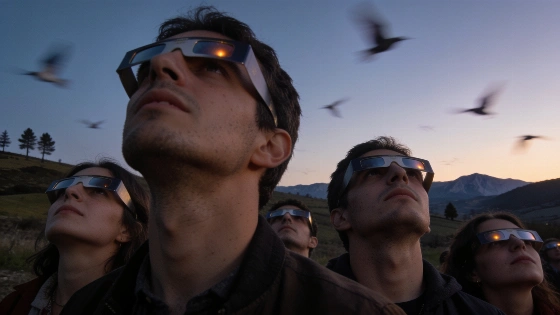
On August 2, 2027, southern Spain will experience a total solar eclipse, with Ceuta seeing the country’s longest stretch of darkness. While Egypt will have over six minutes of totality, Spanish cities are set for a rare event that won’t return this century.
On August 2, 2027, Ceuta will spend nearly five minutes in midday darkness as a total solar eclipse crosses southern Spain. For locals and visitors, it’s a rare chance to watch the sky change in a way that won’t happen again for decades.
Egypt will see the longest totality for this eclipse—six minutes and 23 seconds. In Spain, the window is shorter but still notable. Ceuta will have four minutes and 48 seconds of total darkness, with Melilla close behind at four minutes and 34 seconds. Cádiz and Málaga will see just under three minutes and less than two minutes, respectively. The eclipse will begin between 10:45 and 10:48 in the morning, depending on the city. Elsewhere in Spain, the sun will only be partially covered. The Spanish National Geographic Institute (IGN) and NASA report that the best views will be in Cádiz, Málaga, Granada, Almería, Ceuta, and Melilla, with the exact timing of totality varying by location.
The path of totality will cut across the Strait of Gibraltar, touching Ceuta, Melilla, much of Cádiz, large parts of Málaga, and the southernmost areas of Granada and Almería. Outside this corridor, the eclipse will be partial—impressive, but not the full plunge into darkness that defines a total eclipse. Independent astronomical reports note that Ceuta’s totality, at about 4 minutes and 49 seconds, will be one of the longest visible in Europe during this event.
For comparison, the 2009 eclipse was the longest of the 21st century at six minutes and 39 seconds. The 2027 eclipse will be the longest total eclipse visible from Spain until at least 2114, according to NASA’s catalog. The next chance for a total eclipse in Spain comes in 2053; an annular eclipse in January 2028 will leave a ring of sunlight visible, but not full darkness. IGN notes that regions east and north of the path will only see a partial phase.
During totality, the moon will completely block the sun, revealing the solar corona—a faint halo of plasma rarely seen without special equipment. The sky will darken, stars and planets may appear, and for a few minutes, day will turn to night. Just before and after totality, some may spot Baily’s beads—small points of sunlight shining through lunar valleys—and the diamond ring effect. Eye protection is needed until the sun is fully covered.
Independent astronomical summaries
Standard sunglasses do not protect your eyes during an eclipse. Only certified eclipse glasses that meet ISO 12312-2 standards are safe for viewing the partial phases. Damaged or scratched filters should be thrown away, and using eclipse glasses with binoculars or telescopes is dangerous unless you have special solar filters. The only safe time to remove eye protection is during totality, and only if you are in the path where the sun is completely hidden. In all other cases, looking directly at the sun can cause permanent eye damage.
For those planning to travel to the path of totality, the Spanish National Geographic Institute has an online tool to check local timings and visibility. Interest in Cádiz is already high, echoing the region’s recent attention from major events, including recent military exercises that drew national coverage.
Southern Spain’s coast is expected to draw eclipse chasers, scientists, and curious travelers. Hotels and local authorities are preparing for a surge in demand. The real draw, though, is the rarity of the event and the shared sense of awe it brings. In a world full of digital distractions, a total solar eclipse is one of the few natural events that can quiet a crowd. For Spain, the 2027 eclipse will be remembered long after the shadow has passed.