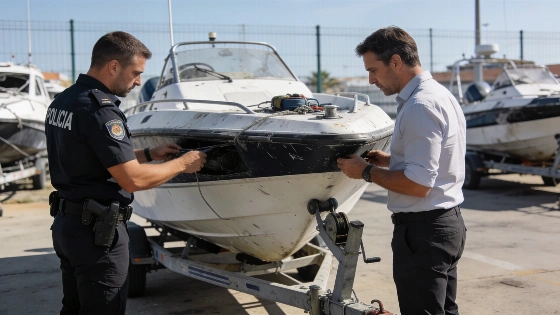
Spanish police have broken up a large-scale migrant smuggling ring. The group moved over 2,000 people and earned more than €24 million. Authorities seized high-speed boats and detained 78 suspects.
Spanish authorities have dismantled what they describe as the largest Algerian-led network trafficking migrants across the Mediterranean, arresting 78 people and seizing assets worth millions. The operation, coordinated by the Ministry of the Interior, targeted a criminal group that organized at least 64 illegal crossings, transporting more than 2,000 migrants to Spain and generating profits exceeding €24 million.
The joint action by the Guardia Civil and Policía Nacional, with support from Europol and police in France, Portugal, and Poland, resulted in 77 arrests in Spain and one in Algeria. Officers confiscated 18 high-speed boats valued at over €5 million, along with €26,675 in cash, large quantities of drugs—including 15,000 MDMA pills, 61 kilograms of hashish, 500 grams of cocaine, and 40 grams of methamphetamine—and several firearms. The group also lost four vehicles, 725 liters of gasoline, satellite antennas, geolocation devices, and other specialized equipment.
Investigators say the organization used powerful boats to smuggle drugs from Spain to Algeria, then returned with migrants bound for the Spanish coast, including Almería, Cartagena, Murcia, Alicante, and Ibiza. Each migrant reportedly paid up to €12,000 for the dangerous journey, with some boats carrying as many as 50 people per trip. The network also profited from drug trafficking and supplying fuel to other criminal vessels.
The Interior Ministry highlights the extreme risks faced by migrants: overcrowded boats, high speeds, rough seas, no lights, advanced navigation systems, and often no life jackets. Many migrants endured long overland journeys through Africa before reaching the Algerian coast for the crossing. The criminal structure, tracked by police since 2023, operated through a complex hierarchy with branches in Andalusia, Murcia, Valencia, and the Balearic Islands, as well as links in France, Portugal, Italy, and Poland.
Leadership was centralized under a single figure who managed planning, financing, and logistics, providing weapons and drugs for distribution in North Africa, where synthetic drugs like MDMA are in high demand. The group was divided into three levels: strategic leadership, operational teams (pilots and transporters), and support roles (recruiters, suppliers, logistics, fuel handlers, financial managers, and front men). The organization maintained a high degree of professionalism, using encrypted communications, satellite phones, and secure safe houses.
Authorities noted a high level of violence within the group, both against its own members and the migrants. Pilots were reportedly trained to confront law enforcement if intercepted at sea. The crackdown comes amid ongoing migration pressures in Spain, particularly in regions like Ceuta, where border security and migrant flows remain a contentious issue. For further context on the broader migration situation in Ceuta and its impact on Spanish-EU relations, see this analysis of recent tensions at the Ceuta border.
Spain has faced increasing challenges from organized crime groups exploiting migration routes across the Mediterranean. The use of high-speed boats and sophisticated logistics has made detection and interception more difficult for authorities. According to official data, the number of irregular arrivals by sea has fluctuated in recent years, with law enforcement adapting strategies to target not only the migrants but also the criminal infrastructure behind these operations. The latest operation underscores the scale and complexity of transnational smuggling networks and the ongoing efforts by Spanish and European agencies to disrupt them.