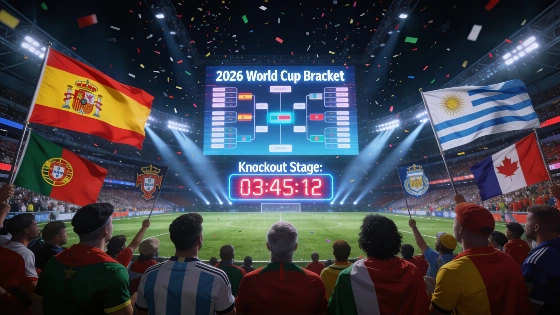
The 2026 World Cup knockout stage is forming, with Spain's next rival still unclear. Group results and last-minute goals could shift the bracket. Several high-profile teams are already through or eliminated.
The 2026 World Cup is entering a decisive phase as the group stage nears its conclusion and the knockout bracket begins to solidify. Spain has secured its place in the last 16, but the identity of its first opponent remains uncertain, hinging on the outcomes of several key matches and group standings.
Multiple scenarios could dramatically alter Spain's route through the tournament. If Portugal wins its final group match, Cristiano Ronaldo's team will top their group and be placed on the same side of the bracket as Argentina, meaning Spain would avoid both until a potential final. However, a draw for Portugal could set up a direct clash with Spain as early as the round of 16, scheduled for July 4. Should Portugal lose and RD Congo achieve a significant win, the Portuguese could drop to third and face a more complicated path, dependent on other results.
Croatia's fate is also pivotal. A win against Ghana would see them finish second and likely face Portugal, with a possible meeting with Spain in the next round if England also wins. If Croatia draws and England loses by more than two goals, Croatia would still finish second and meet Portugal, again opening the door to a Spain-Croatia encounter in the round of 16. Ghana could top their group if they beat Croatia and England fails to win against Panama, which would send England into Spain's side of the bracket for a possible last-16 meeting.
Austria and Algeria are also in contention to face Spain. If Austria wins or draws against Algeria, they will meet Spain in the last 16. If Algeria wins, they take second place and become Spain's opponent. The final group matches will determine which scenario unfolds.
Several last-16 fixtures are already confirmed: Sudáfrica vs Canadá (June 28, 21:00), Países Bajos vs Marruecos (June 30, 03:00), Brasil vs Japón (June 29, 19:00), Costa de Marfil vs Noruega (June 30, 19:00), Estados Unidos vs Bosnia (July 2, 02:00), Alemania vs Paraguay (June 29, 22:30), Francia vs Suecia (June 30, 23:00), Australia vs Egipto (July 3, 20:00), and Argentina vs Cabo Verde (July 4, 00:00). These matchups highlight the global spread of teams advancing to the knockout rounds.
Sixteen teams have already secured their spots in the last 16, including México, Suiza, Estados Unidos, Alemania, Argentina, Sudáfrica, Brasil, Colombia, Francia, España, Bélgica, Marruecos, Canadá, Egipto, Costa de Marfil, Cabo Verde, Países Bajos, Japón, Noruega, Suecia, Ecuador, Australia, Bosnia, Paraguay, and Senegal. Meanwhile, the first teams eliminated from the tournament are Haití, Jordania, Túnez, Turquía, Uzbekistán, Panamá, República Checa, Qatar, Irak, Uruguay, Arabia Saudí, Escocia, Nueva Zelanda, and Curazao.
Spain's qualification is now mathematically certain, with their next match set for June 2 at 21:00 in Los Angeles. Their likely opponent is Austria, but this could change depending on the outcome of the Austria-Algeria match. Other teams such as Inglaterra, Colombia, and Ghana are also close to confirming their places in the knockout stage.
The battle for the best third-placed teams adds another layer of complexity. Eight teams finishing third in their groups will also progress, with FIFA ranking them based on points, goal difference, goals scored, fair play, and, if necessary, a draw. This system means that the bracket can shift dramatically until the final group matches are played.
The knockout schedule is tight: the round of 16 runs from June 29 to July 4, followed by the quarterfinals from July 9 to 12, semifinals on July 14 and 15, the third-place match on July 18, and the final on July 19 at MetLife Stadium in New York/New Jersey. Once the knockout rounds begin, there will be no room for error, and each team will know exactly how many matches stand between them and the World Cup trophy.
For those following the tournament's progress, all highlights and goals from the 2026 World Cup are available on MARCA TV, offering fans a chance to catch up on every key moment. The dynamic nature of the bracket means that favorites like Argentina, Francia, Alemania, and España could see their paths change with a single result. This unpredictability is reminiscent of other major sporting events, such as the recent shake-up in MotoGP standings after the Czech GP, as covered in our report on the Brno circuit's return.
As the group stage draws to a close, the focus remains on the decisive matches that will finalize the knockout bracket. The coming days promise high tension and shifting fortunes for teams and fans alike.
For context, the World Cup knockout format allows for dramatic changes in matchups based on late goals or unexpected results. The inclusion of the best third-placed teams increases the unpredictability, making every group match potentially decisive. The final in New York/New Jersey will mark the culmination of a tournament that has already seen surprises and early exits for several notable teams.