Spanish authorities have dismantled over 4,300 online links tied to ‘The Com’, a violent transnational network. The operation exposed the group’s methods of targeting minors and spreading extreme content. Europol and eight EU countries joined the effort.
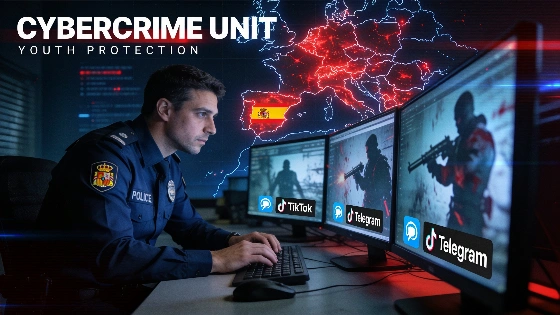
Spanish police have spearheaded a sweeping operation against ‘The Com’, a decentralized online network notorious for distributing violent and illegal content. The coordinated action, which involved law enforcement from eight other EU countries and Europol, resulted in the identification of 4,340 web links hosting illicit material. Authorities moved quickly to alert service providers, demanding the removal of these links to curb the spread of disturbing videos and images.
According to the Ministry of the Interior, more than 2,800 of the detected links were uncovered by the CITCO (Centro de Inteligencia contra el Terrorismo y el Crimen Organizado). The majority of this content was found on TikTok and Telegram, platforms popular among young users. The material included graphic depictions of self-harm, suicide, sexual abuse of minors, animal cruelty, and violent assaults. Officials highlight that ‘The Com’ has rapidly expanded over the past two years, now posing a global threat, as noted in Europol’s latest terrorism trends report.
‘The Com’ is described as a loose conglomerate of fringe groups united by a drive to destabilize social structures through violence and the recruitment of minors. The network lacks a single ideology, but its members are drawn together by a fascination with violence, nihilism, misogyny, satanism, and elements of both jihadist and far-right extremism. Groups linked to ‘The Com’—such as Maniac Murder Cult, No Lives Matter, Colectivo Terrorgram, and 764—are mainly composed of teenagers and young adults, predominantly male.
Police sources report that these groups use social media, gaming platforms, and messaging apps to reach minors and young people, both to recruit new members and to find victims. They often begin with seemingly harmless content tailored to youth culture, then lure individuals into private groups and chats. Within these closed spaces, more intense processes of manipulation, radicalization, and victimization take place. Victims may be coerced into producing child abuse material, self-harming, abusing animals, harassing others, or participating in violent acts. Tactics such as sextortion, threats, and the exposure of intimate images are used to maintain control and force continued participation.
One of the most alarming aspects is the targeting and exploitation of minors, who can become both victims and perpetrators. Offenders exploit vulnerabilities, isolation, or a desire for belonging to build trust and gradually assert control. To evade detection by parents and adults, these groups use coded language, symbols, and emojis that are difficult for outsiders to interpret. Initiation rituals include ‘blood walls’—inscriptions or drawings made with blood featuring the aggressor’s alias or group name—and ‘cutsigns’, where victims are induced to carve the extortionist’s nickname into their skin. These acts are documented and shared as proof of dominance, boosting the perpetrator’s status within the community. Some factions incorporate satanic or extremist symbols to heighten the impact and intimidation of their content, with some incidents even broadcast live to an online audience.
The network’s ecosystem also includes the dissemination of manuals and guides on recruiting and manipulating minors, extortion, murder, bomb-making, and other violent acts. Practices like doxing—publishing personal data to facilitate harassment—and swatting—making false emergency calls to provoke dangerous police responses—are used to intimidate and punish victims. Videos of street assaults, known as ‘manhunt’, and arson are also circulated within these circles.
Spain’s Interior Ministry has prioritized the threat posed by ‘The Com’ in line with the National Counter-Terrorism Strategy. The operation’s findings underscore the evolving risks of online radicalization and the need for ongoing vigilance. According to Europol, the lack of a unified ideology makes these groups unpredictable and difficult to track, while their focus on minors raises significant concerns for public safety. The Spanish-led crackdown demonstrates the growing importance of international cooperation in combating digital extremism and protecting vulnerable youth from exploitation.
In recent years, European authorities have intensified efforts to monitor and dismantle online networks that promote violence and target minors. The rise of encrypted messaging apps and anonymous platforms has complicated detection and enforcement. Spain’s proactive stance in this operation reflects a broader trend among EU countries to address the intersection of cybercrime, terrorism, and youth safety. As digital threats continue to evolve, experts emphasize the need for parents, educators, and service providers to remain alert to the signs of online manipulation and exploitation.