World Cup 2026 Has Begun: New Rules, 48 Teams, and Historic Farewells. The first-ever World Cup featuring 48 national teams has kicked off in the USA, Mexico, and Canada. The tournament is being played under updated rules and may mark the final appearance for Messi and Cristiano Ronaldo.
Today, the 2026 FIFA World Cup kicked off in the USA, Mexico, and Canada—the largest tournament in history, uniting three countries and 48 national teams for the first time. The new competition format has increased the number of participants and changed the structure of both the group and knockout stages, directly affecting the prospects of favorites and debutants alike.
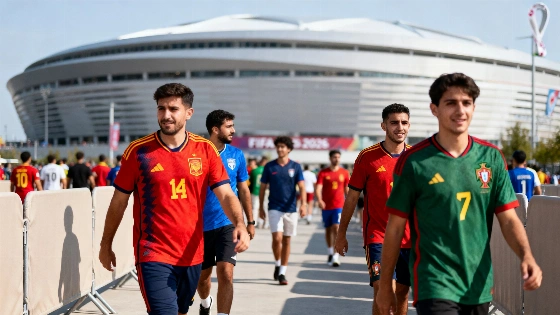
The main innovation is the expansion to 12 groups, which has added an extra knockout round: now, not only the top two teams from each group, but also the eight best third-placed teams advance to the round of 32. This significantly reduces the risk of early elimination for strong teams, but complicates the strategy for energy management at the start of the tournament. The tournament opens with Mexico vs. South Africa, while Spain will begin its campaign only on the fifth day, facing Cape Verde. Spain’s group also includes Saudi Arabia and Uruguay. If Spain finishes second, a matchup with Argentina is possible already in the round of 32.
Among the favorites are Spain, reigning world champions Argentina, France, which recently won back-to-back finals, and Portugal, coming into the tournament after a UEFA Nations League triumph. Special attention is on Germany, which has struggled in the last two World Cups, and on Brazil, now led by Carlo Ancelotti. England also counts on success with Kane and Bellingham.
This year, the tournament could be the last for a number of global football legends. Leo Messi and Cristiano Ronaldo, who have defined world football over the past 15 years, are likely to play in their final World Cup. Among them are Luka Modrić, Neymar, and Salah. At the same time, new stars are emerging: Lamine Yamal, Erling Haaland, Florian Wirtz, Martin Ødegaard, Rayan Cherki, Désiré Doué, and Luis Díaz.
There have also been significant changes in refereeing. VAR has been granted broader powers: the system can now intervene in cases of second yellow cards and wrongly awarded corners. New rules have been introduced to speed up the game: if a substituted player takes more than 10 seconds to leave the field, the replacement must wait a minute; goalkeepers must put the ball back into play within 5 seconds or the opponent will be awarded a corner; players who receive medical assistance must stay off the pitch for at least one minute, unless the foul was punished with a yellow card. Referees are now allowed to send off players for attempting to hide their mouths during disputes or for demonstratively leaving the pitch in protest.
There have also been some high-profile losses. Injuries sidelined key players: Brazil will be without Militão, Rodrygo, and Estevão; Spain — Fermín; France — Ekitike; the Netherlands — Xavi Simons and De Ligt; Germany — Lennart Carl. The championship is also missing stars whose teams did not qualify: Donnarumma, Lewandowski, Kvaratskhelia. In England, Thomas Tuchel left Trent Alexander-Arnold, Cole Palmer, and Phil Foden out of the squad, and in Brazil, Carlo Ancelotti chose not to include João Pedro.
As noted by russpain.com, the tournament final will take place in New York, and Spanish fans will be able to watch the matches on national TV channels. The 2026 World Cup is not only changing its usual format but also becoming a stage for bidding farewell to a whole era in world football.
For reference: the World Cup is held every four years, and Spain has won the tournament only once — in 2010. In 2026, for the first time ever, 48 teams will participate, increasing the number of matches and expanding the geographic reach of the competition. New refereeing and game acceleration rules are designed to boost the tournament's dynamism and transparency. The focus on debutantes and departing stars makes this World Cup particularly significant for fans and experts.