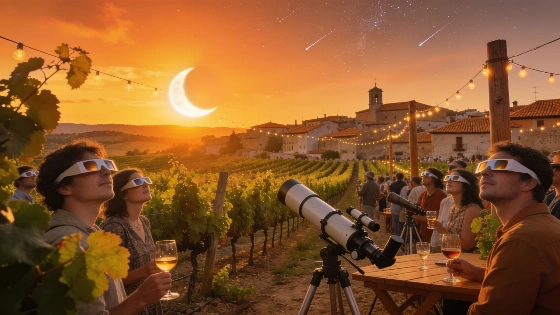
On August 12, Spain will see a total solar eclipse in the north and Mallorca. That same night, the Perseid meteor shower will reach its peak. The combination promises a unique sky event for residents and visitors.
On August 12, 2026, Spain will become one of the best places in Europe to witness a rare astronomical event: a total solar eclipse sweeping across the north of the country and the island of Mallorca, followed by the peak of the Perseid meteor shower after sunset. This combination of two major celestial phenomena on the same day is expected to draw attention from both seasoned astronomers and the general public.
The path of totality for the solar eclipse will cross parts of Greenland, Iceland, and northern Spain, including Mallorca. Residents in these areas will experience a few minutes of daytime darkness as the Moon completely covers the Sun. In cities such as Bilbao, Santander, and across northern regions, the eclipse will be total, while the rest of Spain, including Madrid and Barcelona, will see a significant partial eclipse. In the UK and Ireland, the event will also be visible, with cities like Dublin and Cork seeing over 90% of the Sun obscured.
For those in Spain, the timing of the eclipse is especially notable. The event will occur in the late afternoon and early evening, allowing observers in western Europe to watch the Sun set while partially or totally eclipsed. In major UK cities, the Moon will cover more than 90% of the solar disc, creating a dramatic scene as the Sun dips below the horizon.
Safety remains a priority during the eclipse. Experts stress that looking directly at the Sun without proper protection can cause serious eye damage. Certified solar eclipse glasses are essential for viewing any phase of the eclipse, except for the brief period of totality within the path. Even at sunset, the Sun's rays remain dangerous, and only certified glasses should be used. For those without eclipse glasses, projecting the Sun’s image through a colander or tea strainer offers a safe alternative, especially for children.
As night falls, attention will shift to the Perseid meteor shower, one of the most active and reliable meteor displays of the year. The Perseids occur annually as Earth passes through debris left by comet Swift-Tuttle, producing frequent and sometimes spectacular fireballs. The shower peaks around August 12–13, and this year, the absence of moonlight—thanks to the new Moon phase required for a solar eclipse—will make conditions ideal for meteor watching across the Northern Hemisphere, including all of Spain.
To observe the Perseids, no special equipment is needed. The best approach is to find a dark location away from city lights, allow your eyes to adjust for at least 20 minutes, and watch the sky with the naked eye. Using binoculars or telescopes is not recommended, as meteors can appear anywhere overhead. Observers are also advised to avoid looking at phone screens, as bright light can spoil night vision. Gathering with friends or family can increase the chances of spotting more meteors together.
The coincidence of a total solar eclipse and the Perseid meteor shower is rare. The new Moon phase ensures the night sky will be as dark as possible, maximizing visibility for even faint meteors. This alignment is expected to make the 2026 Perseids particularly memorable for skywatchers in Spain and across Europe.
Interest in astronomical events has grown in recent years, with many residents and tourists planning trips to regions within the path of totality. The Spanish north and Mallorca are likely to see an influx of visitors seeking the best views. For those interested in other major events in Spain during August, Pamplona’s San Fermín festival will also return with expanded TV coverage, as detailed in this report on the upcoming bull runs.
For anyone planning to observe the eclipse and meteor shower, preparation is key. Ensure you have certified eclipse glasses, check local weather forecasts, and choose a safe, dark location for nighttime viewing. The combination of a total solar eclipse and the Perseids offers a unique opportunity for residents and visitors in Spain to experience two of nature’s most impressive spectacles in a single day.
For those wishing to share their experiences, photos and observations of the solar eclipse or Perseids can be sent to contactus@skyatnightmagazine.com.