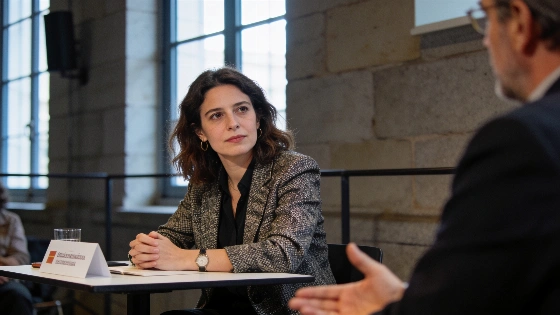
More than 90 literary festivals now operate across Spain. A dispute over sponsorship in Madrid tested the model, but the programme went ahead with leading international and Spanish authors.
More than 30 guests threatened to leave the Festival de las Ideas de Madrid after objecting to Allianz as its sponsor. The insurer holds Israeli bonds and withdrew in mid-September 2026. The programme went ahead with Zadie Smith, Lydia Cacho and Sergio del Molino among its guests.
The dispute put a fast-growing cultural model under an unusually bright light. Spain now has more than 90 festivals built around talks, debates and meetings with authors. Most activities are free.
The 2026 edition of Encuentros de Pamplona/Iruñeko Topaketak is the event’s third biennial edition. Ramon Andrés is its curator, with support from the Government of Navarre, Fundación Baluarte, the la Caixa Foundation and Pamplona City Council.
The sponsor left. The festival did not.
That matters because these events rely on a careful balance. Free access brings in audiences, while private funding helps pay for ambitious programmes. The Madrid dispute also showed how sponsorship can become part of a festival's public identity when a company's financial interests clash with the political views of invited participants. Spanish and international reports said Allianz withdrew after more than 20 cultural figures threatened to boycott the event. Those figures included Rodrigo Sorogoyen, Inés Hernand, Alana S. Portero, Rodrigo Cuevas and P. B. Preciado.
Cristina Fuentes, director of Hay Festival, says the draw is not only famous writers. She argues that conversation gives people a place to examine different ideas in a divided world. A strong exchange between people can become the spectacle itself.
Public reports put the value of Allianz’s sponsorship package at about 124,000 euros and said it included prominent branding on the stage at Plaza de España. The dispute therefore concerned not only funding, but also the visible public identity of the festival.
This format is no longer an experiment in Spain. Hay Festival arrived in Segovia in 2003 and persuaded sceptics that audiences would pay to hear conversations. The organisation now operates across several continents. Encuentros de Pamplona, which made cultural history in 1972 while Franco was in power, returned in 2026 for its third biennial edition.
More festivals have created more competition for funding. Demand has grown too. The new romantic literature festival Somos Infinitos priced tickets at 19,90 euros and sold them all within hours. Spanish press reports have cited the result as evidence of the commercial potential of new literary formats. It gave organisers a clear reason to keep testing them instead of relying only on conventional book fairs.
The wider festival economy is taking several forms. Talks and debates remain central, while meetings with authors are presented as live cultural events with enough identity to attract paying audiences. Many other activities remain free. The gap between free access and Somos Infinitos' fast ticket sales shows how broad the market has become.
Spain's festival map now includes established international brands and events returning after decades of cultural change. The country's appetite for public cultural gatherings also appears in this report on Barcelona's La Mercè programme.
The evidence points to a sector that has moved beyond a small literary circuit. More than 90 festivals, a sold-out 19,90-euro launch and a programme that survived the loss of a sponsor show its reach and staying power. EFE also reported that Madrid mayor José Luis Martínez-Almeida intended to fully review the city's support for future editions after Allianz withdrew. The Madrid dispute made one condition clear. When cultural events invite public argument, their funding choices become part of the programme. That is the cost of making books visible as a live civic experience instead of leaving them on the shelf.