Navantia has begun testing a pioneering air-independent propulsion system in Cartagena, set to transform the S-83 ‘Cosme García’ submarine. This breakthrough could allow Spanish submarines to remain submerged and undetected for weeks, enhancing naval capabilities.
At Navantia’s Cartagena shipyard, engineers have started a critical phase in Spain’s most ambitious naval project: testing the air-independent propulsion (AIP) system destined for the S-83 ‘Cosme García’ submarine. This technology, central to the S-80 program, is designed to let conventional submarines operate submerged for weeks at a time, sharply reducing their risk of detection by enemy sensors and radar.
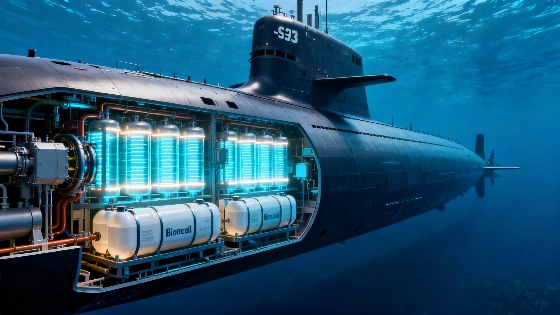
The AIP system, known as BEST AIP, is already installed in a dedicated section of the S-83. Before this module is permanently joined to the submarine’s pressure hull, Navantia is running a series of technical trials to validate its performance. According to the company, the system uses bioethanol reforming to generate hydrogen on board. This hydrogen then reacts with stored liquid oxygen in a proton exchange membrane fuel cell, producing electricity silently and efficiently.
Stealth and Endurance
The operational leap offered by the S-83 lies in its ability to avoid surfacing for air—a maneuver known as snorkeling—for up to three weeks. Traditional diesel-electric submarines must periodically rise to recharge batteries, exposing themselves to detection. With AIP, the S-83 can generate its own power while remaining hidden beneath the surface, opening new possibilities for surveillance, intelligence, and maritime defense missions.
Navantia’s data suggests this autonomy brings the S-83 closer to the capabilities of nuclear-powered submarines, but without the complexity or risks of a nuclear reactor. The result is a vessel that can patrol for extended periods in contested waters, maintaining a low profile and strategic flexibility.
Innovative Fuel Technology
What sets the S-83’s AIP system apart is its use of bioethanol and liquid oxygen as reactants. Instead of storing hydrogen in high-pressure tanks—a logistical and safety challenge—the submarine produces hydrogen as needed through an onboard reformer. This hydrogen feeds the fuel cell, which generates electricity with minimal noise and a high degree of discretion.
Navantia highlights the logistical advantages of this approach: bioethanol is widely available and easier to handle than compressed hydrogen, reducing operational risks and simplifying supply chains. The ongoing tests in Cartagena are designed to simulate real-world conditions, using a specialized facility that replicates the submarine’s bow, stern, depth, and speed.
S-80 Program Milestone
The S-83 ‘Cosme García’ is the third vessel in the S-80 class and the first to be built with the AIP system from the outset. Earlier submarines in the series, the S-81 ‘Isaac Peral’ and S-82 ‘Narciso Monturiol’, are scheduled to receive AIP retrofits during future maintenance periods, while the S-84 will also be equipped with the system during construction.
Navantia emphasizes that the S-80 submarines are entirely Spanish in design and manufacture, measuring around 80 meters in length and displacing approximately 3,000 tons submerged. They are engineered for long-range missions with a reduced crew and feature advanced combat and sensor systems.
The start of AIP testing marks a decisive step for the S-80 program. If successful, the S-83 will represent a technological milestone for Spain’s naval industry and reinforce Cartagena’s status as a strategic hub for submarine construction.
For context, air-independent propulsion is increasingly seen as a game-changer in conventional submarine design, offering a balance between endurance, stealth, and operational flexibility. Spain’s investment in this technology signals its intent to remain at the forefront of naval innovation in Europe.