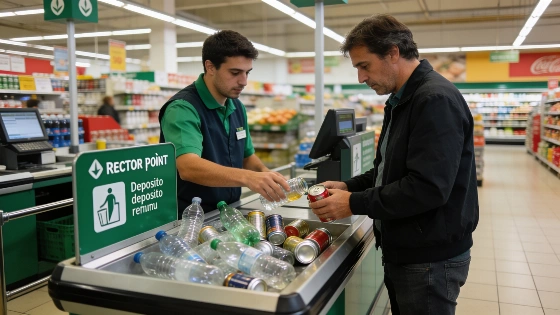
From November, Spain will require a deposit on single-use drink containers. Consumers will pay at purchase and get the money back when returning the empty packaging. The move aims to boost recycling rates.
Spain will introduce a mandatory deposit system for single-use beverage containers starting this November, marking a significant shift in how drinks are sold and disposed of nationwide. Under the new rules, every plastic bottle, can, or carton included in the scheme will carry a minimum deposit of 10 cents, paid by the consumer at checkout and refunded upon return of the empty container. This measure is designed to increase recycling rates and bring Spain in line with European Union targets after the country failed to meet previous collection goals.
The deposit will apply to a wide range of drinks, including mineral and spring water, juices, nectars, soft drinks, energy and isotonic beverages, and certain alcoholic drinks, provided they are sold in plastic bottles up to three liters, cans, or beverage cartons. Each eligible container will be clearly marked so consumers know it is part of the system and that the deposit can be reclaimed. For example, buying a six-pack of cans will require an additional 60 cents upfront, which is fully refundable if all containers are returned.
Not all packaging will be affected. Glass bottles, milk and dairy products, wine, and some spirits are excluded, reflecting specific exemptions in both Spanish and EU regulations. The system focuses on packaging that can be efficiently collected and recycled separately, aiming to improve both the quantity and quality of recovered materials.
The move comes after Spain missed its 2023 target for separate collection of single-use plastic bottles. The law required a 70% collection rate, but the actual figure reached only 42.3%, according to the Ministry for Ecological Transition. This shortfall triggered the legal obligation to implement a deposit, return, and refund system. The traditional selective collection model left many bottles outside the recycling stream or mixed with other waste, reducing recovery rates. The new approach is expected to ensure containers are returned directly to collection points, increasing the likelihood of proper recycling.
Retailers will need to adapt their operations to handle the return and refund process, which may involve changes to store layouts and staff routines. The deposit is not considered part of the product price and is not subject to VAT, functioning instead as a recoverable security. The aim is not to make drinks permanently more expensive, but to attach a tangible value to packaging that was previously discarded without economic consequence.
Spain is following the example of several European countries where deposit systems have already delivered high return rates. Germany and Denmark, for instance, have long operated similar models, while Portugal recently launched its own national scheme. The European Union has set a binding target for member states to achieve at least 90% separate collection of single-use plastic bottles and metal drink containers by January 1, 2029. Only countries that consistently meet these targets can avoid mandatory deposit systems. The Spanish government’s decision reflects growing pressure to align with these standards and avoid further penalties.
For context, Spain’s approach to environmental challenges has included substantial financial interventions in recent years. For example, the government allocated €165 million to Ceuta to address local crises, as detailed in a previous report on emergency funding for Ceuta. The new deposit system represents another step in adapting national policy to European requirements and environmental realities.
Deposit return systems are widely recognized as effective tools for increasing recycling rates and reducing litter. By making consumers responsible for returning packaging, these schemes help ensure that valuable materials are recovered and reintroduced into the production cycle. As Spain prepares for the November rollout, both retailers and consumers will need to adjust to the new process, which is expected to bring the country closer to EU recycling targets and reduce the environmental impact of single-use packaging.