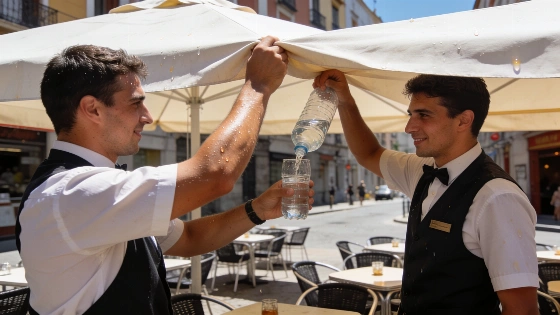
Spain’s hospitality sector faces new climate safety rules after a landmark agreement between unions and employers. The changes focus on protecting outdoor workers during heatwaves, but do not require automatic terrace closures or introduce new fines.
On April 13, Spain’s leading hospitality unions and employer associations signed a significant update to the sector’s national framework, aiming to address the growing risks posed by extreme weather. The revised agreement, known as the VI ALEH, introduces new obligations for climate risk prevention but does not mandate the automatic closure of terraces during heatwaves—a point that has generated confusion among business owners and staff alike.
The new rules, agreed by FeSMC-UGT, CCOO Servicios, Hostelería de España, and CEHAT, focus on three main areas: LGTBI protections, disaster and weather risk prevention, and procedural safeguards before disciplinary dismissals. While the agreement highlights the need for updated information and effective measures during red weather alerts, it does not specify temperature thresholds, set closing times, or establish a dedicated penalty system for non-compliance. Instead, the core requirement is for employers to protect staff by adapting tasks or schedules when risks cannot be otherwise controlled.
What the Agreement Actually Changes
Despite speculation, there is no new law in Spain that forces all terraces to close when temperatures rise. The official statement from the signatories describes the areas covered but avoids imposing blanket rules. According to the latest official records, the April modification has not yet been published in the BOE (Spain’s official state bulletin), leaving some uncertainty about its immediate legal status.
Under the revised framework, businesses are expected to monitor weather alerts and implement practical steps to reduce risk. This could mean providing shade, water, and more frequent breaks, or shifting heavy tasks to cooler hours. If these measures are not enough to guarantee safety, employers must adapt work schedules or, in some cases, suspend outdoor service. However, any closure of a terrace would be a targeted response to a specific risk assessment—not a universal order affecting all establishments.
No Blanket Closures or Automatic Fines
The agreement does not introduce new fines for keeping terraces open during heatwaves. The figure of nearly €50,000 cited in some reports refers to Spain’s general labor law, where a serious breach of safety regulations can result in penalties up to €49,180. However, such fines require a formal administrative process and are not triggered simply by operating a terrace in hot weather. Both Hostelería de España and CCOO have clarified that the agreement leaves the choice of measures to each business, based on their own risk evaluations and the severity of the weather event.
Legal Requirements for Outdoor Work
Since May 2023, Spanish law obliges employers to take appropriate action during adverse weather, including extreme heat. The Real Decreto 486/1997 requires risk assessments that consider the type of work, exposure, and individual circumstances of employees. If safety cannot be ensured, certain tasks must be suspended during high-risk periods. This applies directly to outdoor hospitality work, such as serving on terraces.
When the national weather agency AEMET or a regional authority issues an orange or red alert, businesses must review their safety measures. If existing protections are insufficient, they are required to adjust working conditions—potentially by reducing hours, changing shifts, or moving staff indoors. The law emphasizes that organizational changes, not just access to water, are necessary to protect workers from heat-related risks.
What Bars and Restaurants Must Do
Hospitality businesses are now expected to check forecasts, update risk assessments, and clearly communicate instructions to staff before continuing outdoor service during heat alerts. The National Institute for Occupational Safety and Health (INSST) recommends providing water, shaded or air-conditioned areas, more frequent breaks, and rotating staff. Heavy tasks should be scheduled for cooler times of day. If these steps do not sufficiently reduce risk, employers must modify schedules, shorten shifts, or suspend terrace service as needed. In cases of imminent danger, workers have the right to stop work and leave the area, provided they inform their supervisor or workplace safety representative.
While the new agreement marks a step forward in climate safety for Spain’s hospitality sector, it stops short of imposing blanket rules or automatic penalties. The responsibility remains with each business to assess risks and act accordingly, balancing the realities of outdoor service with the growing threat of extreme heat.
As Spain continues to experience hotter summers, the hospitality industry faces increasing pressure to adapt. The latest agreement signals a shift toward more proactive safety measures, but leaves the details—and the ultimate decisions—at the local level.