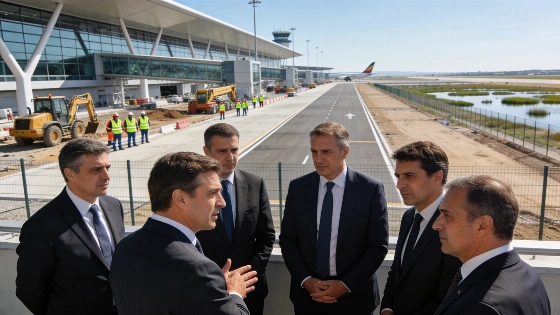
Spain’s government has approved DORA III, setting a minimal rise in airport fees and a €13 billion investment plan. The move has drawn sharp criticism from coalition partner Sumar and major airlines, exposing deep divisions over the future of Spanish aviation infrastructure.
Spain’s Council of Ministers has approved the new Documento de Regulación Aeroportuaria (DORA III) for 2027 to 2031, setting a 0.33% annual increase in airport fees and authorizing a €13 billion investment plan for the country’s airports. A regulatory deadline at the end of September drove the timing, allowing the new rules to take effect without delay. The decision has instead exposed divisions within the government and the aviation industry.
Sumar, a coalition partner, quickly criticized the plan. Culture Minister Ernest Urtasun rejected the push for airport growth, particularly the planned extension of Barcelona’s El Prat runway. He warned that the project would damage protected wetlands and worsen unsustainable tourism. Urtasun called on the European Union to block the expansion, which threatens La Ricarda, a Natura 2000-listed lagoon.
A impressive share of DORA III’s €13 billion investment is already earmarked for specific airports: approximately €1.765 billion for Barcelona-El Prat and €4.4 billion for Madrid-Barajas. El Prat’s funds will focus on preparatory work for future expansion.
The government describes the fee increase as minor, about three cents per year after an 11% rise since 2024, but airlines are unconvinced. Ryanair, which has already cut three million seats from Spanish regional airports for 2025 and 2026, blames high Aena charges for limiting growth. CEO Michael O’Leary and Transport Minister Óscar Puente have publicly disputed the cause of the cuts: O’Leary points to airport tariffs, while Puente blames Boeing delivery delays. Ryanair’s official statement on DORA III was blunt: “The government has missed a major chance to boost traffic, tourism and jobs by not reducing Aena’s already excessive fees.”
The Association of Líneas Aéreas (ALA) shares Ryanair’s concerns. Although it calls the fee path “moderate,” the group warns that Aena could end up with excessive regulated profits, hurting airlines and passengers. Even a small increase after recent hikes could make Spain less competitive and reduce passenger numbers. Industry reports say ALA has specifically warned that the new rules could weaken Spain’s position as an aviation hub without careful management.
The investment plan is also under scrutiny locally. In Menorca, the Partido Popular has urged Aena to prioritize urgent needs, such as a new control tower, over expansion. Recent flooding in the current tower, highlighted by unions CCOO and USCA, has exposed the vulnerability of existing infrastructure and the gap between major investment announcements and day-to-day problems.
DORA III will draw most of its funding from revenues generated by the Aena-managed airport system, not Spain’s general state budget. Industry sources say this approach is intended to ensure financial sustainability without direct reliance on public funds.
Despite the criticism, the government is moving ahead. DORA III sets aside €191.25 million for preparatory work on the El Prat runway extension, signaling that environmental and political objections are unlikely to stop the project for now. Officials present the plan as a balance between maintaining infrastructure and allowing future growth. Still, ongoing disputes with Sumar and the airlines show that agreement remains out of reach.
The government is trying to project stability and ambition, while airlines and coalition partners accuse it of ignoring environmental limits and economic pressures. DORA III’s approval reflects a calculated risk more than consensus: the government hopes small fee increases and major investments will keep Spain’s airports competitive even as political and environmental costs rise. For now, it is pressing ahead and absorbing the criticism, with the promised benefits still unproven as disagreements deepen.