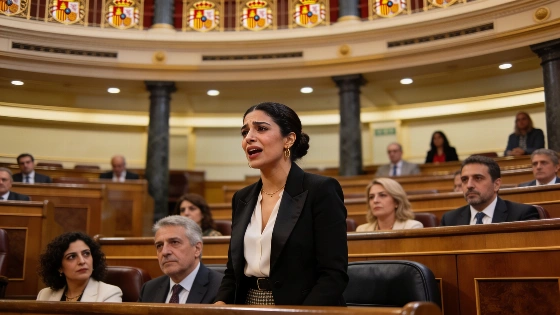
Spain’s Congress has approved the first step to grant citizenship to tens of thousands of Sahrawis born in the former Spanish colony. The move comes amid a crisis in Ceuta and sharp divisions among parties. The government’s allies call it historic.
Spain’s Congress has voted to restore Spanish nationality to Sahrawis born in Western Sahara before 1977, ending years of political deadlock on the issue. The measure, which could affect between 70,000 and 110,000 people according to estimates from EFE and Spanish media, passed with 168 votes in favor, 31 against from Vox, and 145 abstentions from the Partido Popular (PP) and Junts. The law was promoted by Sumar and led in parliament by Más Madrid deputy Tesh Sidi. It marks a clear shift in Spain’s approach to its colonial legacy and its relationship with Morocco.
The vote comes as Spain faces a migration crisis in Ceuta and renewed pressure from Morocco, a context noted by several Spanish news agencies. For decades, Sahrawis who lost Spanish nationality after the end of Franco’s dictatorship have lived in legal limbo. Previous attempts to address their status were blocked or ignored. Now, with the government’s partners calling the move "historic" and "a long-overdue act of justice," the political cost of inaction has become harder to justify.
The draft law allows not only Sahrawis born before 29 September 1977 to apply for citizenship, but also their direct descendants, who will have a separate application window after their parent is recognized.
Sumar’s Enrique Santiago pointed out that since 2014, parties including Izquierda Unida, ERC, Unidas Podemos, and Sumar have tried and failed to pass similar laws. The breakthrough came after the PSOE agreed to key changes, such as shifting the language from "the Sahrawi people" to "Sahrawis" and clarifying that eligibility covers anyone born in the former Spanish province before 29 September 1977, regardless of where they live now. The law gives these individuals the same path to citizenship as Sephardic Jews and Latin Americans, bypassing standard residency requirements. According to RTVE and other Spanish outlets, the process will use the exceptional "carta de naturaleza" route, so applicants do not need to have lived in Spain for a set period.
The vote also exposed deep political divides. Vox opposed the measure, calling it a "gift" of Spanish nationality and demanding tighter controls. The PP and Junts abstained, criticizing the government for inconsistency and accusing Prime Minister Pedro Sánchez of abandoning Spain’s traditional "active neutrality" on Western Sahara. PP spokesperson Pedro Muñoz Abrines argued that the PSOE’s change of course was driven by commercial interests and personal agendas, pointing to Sánchez’s 2022 letter to Morocco’s king as a turning point.
For Tesh Sidi, who came to Spain as a child refugee from the Sahrawi camps and is now an engineer and parliamentarian, the vote was personal. She called for courage in the face of Moroccan pressure and thanked even those who abstained, stressing the need for unity. The session was marked by visible emotion, with deputies and guests—including the Polisario Front’s ambassador to Spain—present for what many described as a long-overdue correction of a historical wrong.
The law also introduces a broader set of acceptable documents to prove Sahrawi origin, such as old Spanish IDs, administrative records, birth certificates, and entries in the Western Sahara referendum registry, reflecting the complex historical documentation of the territory.
Not all government allies were satisfied. Podemos and others accused the PSOE of delaying action for years to avoid upsetting Morocco, while ERC and Junts argued the law does not go far enough because it does not call for a referendum on Sahrawi self-determination. Vox’s Ignacio Hoces said Spanish nationality should not be used as compensation for past injustices and called for stricter safeguards.
The context is hard to separate from the vote. The PSOE’s shift came as irregular migration into Ceuta surged and Spain’s border with Morocco drew renewed attention. The law passed just days after a surprise in the Justice Committee and amid ongoing diplomatic tension. It signals a change in Spain’s priorities that could complicate relations with Rabat but answers a longstanding demand from within Spain’s political spectrum. According to several Spanish media reports, the general naturalization regime for Sahrawis living in Spain is also being reformed, reducing the required legal residency period to two years, similar to other privileged categories.
Restoring citizenship to Sahrawis born under Spanish rule is more than symbolic. It reopens a chapter Spain has tried to keep closed for fifty years, with real consequences for thousands who have lived in legal uncertainty. The move also highlights the difficulty of balancing historical responsibility with current politics. While the government’s partners celebrate the vote, the abstentions and opposition show that consensus is still out of reach. The PSOE’s sudden support, after years of resistance, looks more like a response to mounting pressure than a change in principle. Whether this law leads to lasting change or becomes another episode in Spain’s uneasy reckoning with its colonial past remains to be seen.