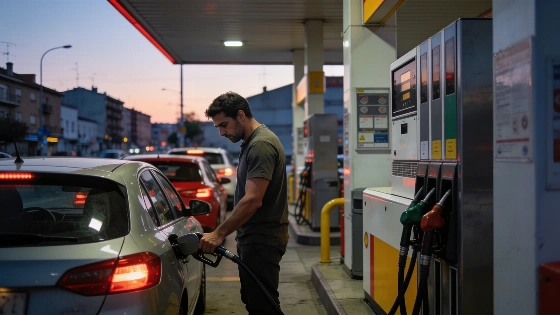
With fuel prices already near record highs, Spanish motorists are being advised to refuel before September 17. An upcoming price update and international tensions could push costs even higher in the coming days.
Drivers across Spain are facing another round of fuel price hikes. With costs already at their highest in months, experts are advising motorists to fill up before September 17, when the next price update is expected to push prices even higher.
Recent data from the European Union’s Oil Bulletin shows the average price of gasoline in Spain reached 1.816 euros per litre in early September, after ten straight weeks of increases. Diesel is close behind at 1.795 euros per litre, and in some areas, prices have already passed the two-euro mark. According to the European Commission and independent market monitors, this trend continued: by September 11–13, average gasoline prices in Spain were around 1.84–1.85 euros per litre, rising further to about 1.886 euros per litre by September 15.
The next scheduled update of European fuel prices is set for Thursday. Analysts point to ongoing international tensions, especially in the Middle East, as a major factor disrupting energy markets and driving up costs. The European Commission confirms that these geopolitical pressures are directly affecting prices for both gasoline and diesel. Even with the recent increases, Spain’s fuel prices remain below the EU average, where gasoline is about 2.041 euros per litre and diesel is 2.107 euros per litre.
For Spanish drivers, the message is straightforward: refuel now or risk paying more in just a few days. The difference could be significant, especially for those with long commutes or travel plans. Prices vary widely between stations, so it pays to compare before filling up. In some areas, the cost per litre has already topped two euros, and independent reports note that some stations are charging as much as 2.23 euros per litre.
This month, gasoline has overtaken diesel in price for the first time since March. The main reason is government subsidies: in September, diesel gets a 20-cent per litre discount, while gasoline receives only five cents. These subsidies are set to last until the end of the month, giving diesel drivers a temporary break but offering little relief for those who use gasoline.
Anyone needing to refuel would be wise to do so before Thursday. Waiting could mean paying more, as the new European pricing takes effect and local stations adjust their rates. As reported earlier, price competition and market volatility are now a regular part of Spain’s automotive market, with drivers increasingly sensitive to even small changes.
The current spike in fuel prices is part of a broader pattern of instability in global energy markets, where supply disruptions and geopolitical uncertainty can quickly affect what consumers pay. While government subsidies help for now, their limited duration means Spanish households and businesses remain exposed to future increases. In the coming days, drivers will have to decide whether to act on these warnings. For now, the safest bet is to fill up, compare prices, and prepare for a potentially expensive autumn on Spanish roads.