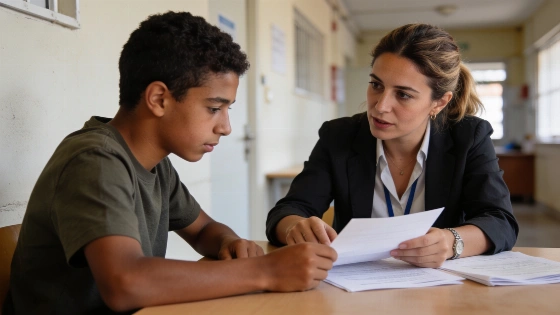
Spain’s Supreme Court has ruled that migrant minors, regardless of origin or status, cannot be deported en masse. Each case must be reviewed individually, with full legal protections and oversight.
Spain’s highest court has drawn a clear line: migrant children, whether they arrive in Ceuta or elsewhere, are entitled to the same legal protections as Spanish minors. The Supreme Court’s 2024 decision, which declared the collective return of 55 unaccompanied minors to Morocco illegal, has set a binding precedent. This ruling directly challenges calls from political leaders, including the head of the Partido Popular, Alberto Núñez Feijoó, who recently argued for the immediate return of all minors who entered Ceuta in late July, regardless of their age or circumstances.
Under Spanish law, every foreign minor found in the country must be treated first and foremost as a child. The Law on the Legal Protection of Minors guarantees access to education, healthcare, and social services on equal terms with Spanish children. When authorities encounter an undocumented minor, the police are required to notify child protection services and the public prosecutor, who then oversees age determination and ensures the child’s rights are respected throughout the process.
Once a minor’s age is confirmed, the child is placed under the care of regional protection services. The next steps involve gathering information about the child’s family situation, often with the help of diplomatic channels. If there is enough evidence to support family reunification, the government may initiate repatriation proceedings. However, this is never automatic. The law requires that each child be heard and that any decision is made on an individual basis, always prioritizing the child’s best interests.
In some cases, returning a child to the protection services of their country of origin is considered, but only if those services can guarantee adequate care. The process is lengthy, often taking months, and any decision can be appealed in court. Immediate or collective expulsions are explicitly prohibited. If repatriation is not possible, the child remains under Spanish protection, typically in residential care centers, as family placement is rarely feasible for older minors.
The 2021 mass arrival of migrants in Ceuta exposed the risks of bypassing these safeguards. Spanish authorities began returning unaccompanied minors to Morocco without individual case files or proper assessment of their personal and family circumstances. The Supreme Court later ruled these actions illegal, citing a complete disregard for the procedures set out in the Foreigners Law and describing the returns as collective expulsions. In 2025, the Provincial Court of Cádiz went further, convicting Ceuta’s former government delegate and vice president for knowingly authorizing these unlawful returns.
Officials had relied on a 2007 cooperation agreement between Spain and Morocco, which outlines support for the return of Moroccan minors. However, the courts found that this agreement does not override the procedural guarantees required by Spanish law. Each minor must have an individual file, their circumstances must be investigated, and the prosecutor must be involved before any return is considered. The Supreme Court also rejected the argument that exceptional circumstances, such as mass arrivals, justify relaxing legal standards.
It is not enough for Morocco to accept the return of minors; Spanish authorities must still comply fully with domestic law. The court made clear that bilateral agreements cannot replace constitutional and legal obligations. As a result, any attempt to carry out mass deportations of minors, even in crisis situations, is now firmly blocked by Spanish jurisprudence.
For context, the legal debate over the treatment of migrant minors in Spain has intensified in recent years, especially in regions like Ceuta and Melilla. The issue has sparked political tensions and legal scrutiny, as seen in other high-profile cases involving local officials and controversial decisions. For example, the recent investigation into Carboneras councillors over delays in a key demolition vote, covered in detail by RUSSPAIN’s report on the Algarrobico hotel case, highlights how legal compliance and individual rights remain central themes in Spanish public life.
Spain’s approach to migrant minors is shaped by both national and international obligations. The country is a signatory to the UN Convention on the Rights of the Child, which requires that the best interests of the child guide all decisions. In practice, this means that even in the face of political pressure or logistical challenges, Spanish authorities must ensure that every minor’s case is handled with care, transparency, and respect for due process. The Supreme Court’s stance reinforces this commitment, making it clear that legal protections cannot be set aside, even in moments of crisis.