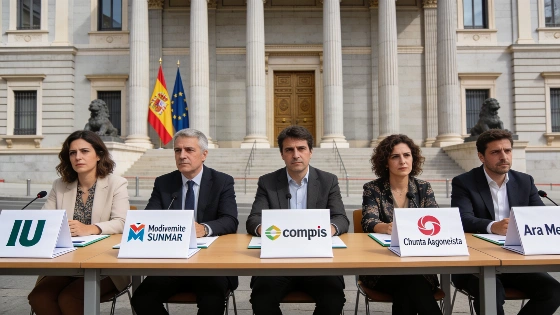
Five months after the 'vía Rufián' push, Spain's left remains divided. Key parties have not expanded their alliance. New splits and stalled talks raise doubts about unity before the next elections.
Efforts to unify Spain's left-wing parties have stalled, with major groups like IU, Movimiento Sumar, Más Madrid, and Comunes failing to expand their alliance five months after the high-profile 'vía Rufián' initiative. Despite public optimism about possible agreements with Compromís, Chunta Aragonesista, and Ara Més, no new parties have formally joined the coalition. The situation leaves the left fragmented as the country looks ahead to future general elections.
The push for unity began in February, when Gabriel Rufián, spokesperson for ERC in Congress, called for a broad left-wing alliance. Days later, IU, Movimiento Sumar, Más Madrid, and Comunes announced their own pact, aiming to bring in as many parties as possible. However, the momentum has faded. Rufián's proposal failed to gain traction even within his own party, and other key regional forces like EH Bildu, BNG, and Adelante Andalucía have rejected integration. Meanwhile, the four-party alliance has not managed to attract new partners, and Podemos, which ran independently in 2023, continues to chart its own course with Irene Montero as its candidate.
Instead of consolidation, new splits have emerged. Adelante Andalucía, which only ran in Cádiz in 2023, now plans to contest all Andalusian provinces, increasing the risk of vote dispersion in Spain's most populous region. In the Canary Islands, Drago, which previously joined Sumar, now considers another agreement "highly unlikely," citing dissatisfaction with its treatment inside the coalition. The party's leadership described the experience as a "fraud" for the Canary Islands.
Internal tensions are also visible in Madrid. Más Madrid recently ruled out a coalition with IU for the next regional elections, though it left the door open for local agreements in municipalities where cooperation already exists. The Madrid branch of IU is not aligned with the national leadership, complicating negotiations further. These unresolved disputes highlight the challenges facing the left as it seeks to present a united front.
Rufián's original vision centered on a coalition led by "sovereignist lefts," but most of the targeted parties have distanced themselves. ERC's leadership, including Oriol Junqueras, has consistently rejected integration with Spanish left-wing groups. EH Bildu and BNG will also run independently in future elections. While Sumar's coalition partners have not openly dismissed Rufián's call, they have continued to build their own alliance without incorporating his proposal.
Within the current alliance, leaders point to improved coordination compared to the initial Sumar phase. However, they still lack a unified candidate and brand, and have not expanded their roster. Talks with Compromís, Chunta Aragonesista, Ara Més, and the Partido Verde are ongoing, but progress is slow. Party representatives express hope for breakthroughs by September, but emphasize the need to respect each group's timeline and autonomy.
Regional parties like Compromís, Chunta, and Ara Més insist on maintaining their distinct identities and strong territorial presence. Compromís is open to alliances but wants to negotiate from a position of strength, possibly after forming its own coalition for regional and municipal elections. Chunta's leadership favors a single, left-wing, Aragonese list, but insists that any coalition must be led by their party to maximize impact. Ara Més, representing the Balearic Islands, is willing to engage in dialogue but demands recognition as a separate political space.
Other former Sumar partners show mixed attitudes. Drago is unlikely to rejoin, while Partido Verde and Iniciativa del Pueblo Andaluz are moving toward renewed cooperation. The role of Podemos remains uncertain, as longstanding tensions with Más Madrid and Movimiento Sumar persist. Although contacts continue, Podemos has not announced any new alliance plans.
This ongoing fragmentation could undermine the left's electoral prospects. In 2023, Sumar needed 12.3% of the vote to secure just 8.8% of seats, and failed to win representation in 29 provinces with small seat allocations. Current polling suggests Sumar's support has dropped to 6%, raising the risk of losing seats in even larger constituencies. Spain's electoral system penalizes divided parties, making unity a practical necessity for left-wing groups hoping to influence future coalition governments.
Spain's left-wing landscape has historically been marked by shifting alliances and regional dynamics. The country's proportional representation system, combined with strong territorial parties, often complicates efforts to build broad national coalitions. As the next election cycle approaches, the ability of these parties to overcome internal divisions and present a cohesive alternative will be closely watched by both supporters and political rivals.