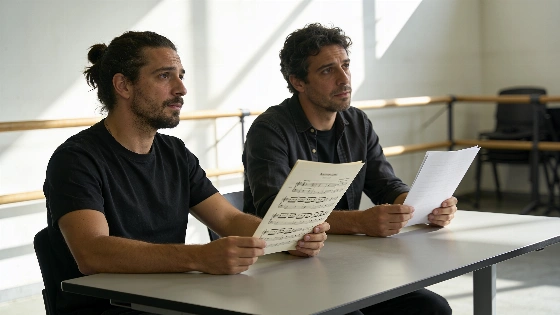
Iván Macías and Félix Amador, the creative duo behind several major productions on Madrid’s Gran Vía, are setting their sights on Broadway with Impulse Scena, an initiative to connect European and American musical theatre. Its first major project is Carmen, a New York Story, a contemporary reworking of Prosper Mérimée’s classic character. The Brno production credits Macías with the music and Amador with the libretto.
Based at the Liceo Municipal de la Música de Moguer in Huelva, Macías and Amador have spent over a decade building a reputation for ambitious, export-ready musicals. Their partnership began with Germinal in 2015 and has since produced titles including El médico, La historia interminable, El tiempo entre costuras and Los pilares de la tierra, all of which have drawn large audiences in Madrid. With four major productions behind them, they are now working to build a steady creative channel with Broadway and show that Spanish-originated works can compete internationally.
Carmen, a New York Story moves Mérimée’s story to present-day New York, recasting Carmen as a Hispanic immigrant seeking a new life in the United States amid crime and drugs. The story unfolds in an immigrant community, where Carmen works in a bar alongside women looking for chance and a fresh identity. Its urban setting, including imagery of the Statue of Liberty, takes the character beyond the traditional Spanish milieu while preserving themes of danger, desire, freedom and marginalization.
The Brno production is scheduled to make its world premiere on 24 and 25 October 2026 at the Hudební scéna, the musical theatre stage of Městské divadlo Brno. Director Stanislav Moša leads the staging, with Kristýna Daňhelová and Lesana Krausková listed in the title role. The announced cast also includes Libor Matouš, Estructura Salvadori, Lukáš Janota, Aleš Slanina, Esther Mertová and Irena Freudenschussová. Those dates give the project a concrete production key stage as the team pursues further development in New York.
The Brno theatre has worked with Macías and Amador before, on the musical Medicus. In coverage by Novinky.cz, Moša said the creative team had “complete freedom” to develop the new adaptation. The project builds on an established relationship between the Spanish creators and a Czech producing institution.
The character of Carmen has been reinvented across musical and screen forms. Oscar Hammerstein II’s musical Carmen Jones, which premiered in 1943, moved the story to an American setting. The 2001 film Carmen: A Hip Hopera, starring Beyoncé, offered another modern reimagining. Macías and Amador continue that tradition by centering the contemporary experience of a Hispanic immigrant in New York.
Macías and Amador say they aim to reach Broadway and show that Spain can produce high-quality musicals for export. They point to European production costs and the worldwide appeal of universal themes in their work. Amador says their stories are made to resonate with audiences in Spain and around the world, and that emerging Asian markets are also targets for future premieres.
Brendan Walsh, a New York-based theatre producer, is backing their international ambitions as Impulse Scena’s strategic partner in the United States. The collaboration is expected to open new opportunities for Spanish musicals in the American market, where the industry’s scale and structure bring both challenges and potential rewards.
One major career breakthrough came when they secured the rights to adapt El médico, Noah Gordon’s renowned novel. The author’s family initially rejected the proposal, but later approved it after Macías and Amador presented a musical prologue that convinced Gordon of their vision. The production has since reached nearly a thousand performances and earned international recognition, strengthening the case for exporting Spanish musical theatre.
As he develops Carmen, a New York Story, Macías is also working on Patria, a stage adaptation of Fernando Aramburu’s novel. He says he is taking a different approach to the music, aiming to convey emotions the text leaves unspoken without imposing ideological positions.
Both creators say their journey is far from over. Macías, now based in Madrid but often back in Moguer, stresses the importance of persistence and continued learning. Amador, who still lives in Moguer for most of the year, draws creative inspiration from his hometown’s artistic heritage.
Their working process is intense and sometimes contentious, with regular debates and differing perspectives. They agree those creative tensions strengthen the final product. Macías recalls being asked in New York why he continues to work with Amador; he replied that reliability and humility underpin their partnership.
Spain’s musical scene has grown significantly in recent years, with more productions reaching international stages. The deaths of influential figures, including Ángel Alonso, founder of Sala Villarroel in Barcelona, have also prompted a period of transition and reflection in the industry. For more on the impact of such figures, see this overview of Barcelona’s theatre legacy: Barcelona’s theatre community mourns a visionary founder.
Spain’s presence in global musical theatre is growing through ambitious creative work and strategic partnerships, including adaptations of classic stories for new audiences. As Macías and Amador prepare to launch Carmen, a New York Story internationally, their work reflects the changing place of Spanish productions on the world stage.
Over the past decade, Spain’s musical theatre sector has expanded rapidly, with Madrid’s Gran Vía emerging as a hub for domestic and international premieres. Lower production costs and a deep pool of creative talent have made the country an attractive base for new works. As Spanish teams work more often with international partners, the scope for further exports and cross-cultural projects continues to grow.