Ángel Alonso, a key figure in Barcelona’s theatre scene and founder of Sala Villarroel, has died at 84. His legacy includes groundbreaking productions and a lasting impact on Catalan culture.
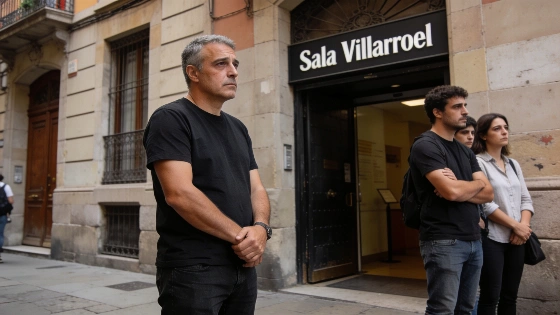
Ángel Alonso, one of the most influential figures in Catalan theatre, has died in Barcelona at the age of 84. Known for his uncompromising vision and commitment to artistic freedom, Alonso was a driving force behind the Sala Villarroel, which he co-founded in 1972. His death marks the end of an era for Barcelona’s performing arts community, where his presence shaped decades of cultural life.
Alonso’s leadership at Sala Villarroel transformed the venue into a hub for progressive and alternative theatre. From its beginnings as a space “close to the working class,” the theatre became a platform for both local and national talent, offering a diverse and often provocative program. Under his direction, the Villarroel navigated the turbulent years of Spain’s transition from dictatorship to democracy, even surviving a bombing in 1977 during a performance of La sangre y la ceniza, a work by Alfonso Sastre staged by El Búho. This incident underscored the risks faced by artists committed to social and political change during that period.
Despite his reputation as an agitator and advocate for libertarian ideals, Alonso achieved unexpected commercial success with the production of La extraña pareja in 1994. Starring Paco Morán and Joan Pera, the play ran for five years, surpassing two thousand performances and drawing over a million spectators. The scale of this achievement surprised even Alonso himself, who was more accustomed to the alternative scene. The production, backed by Focus, became one of the most-watched shows in Spanish theatre history and remains a reference point for the industry.
Alonso’s career was defined by his willingness to take risks and challenge conventions. He was closely associated with works like Historias de la puta mili, an adaptation of Ivà’s anti-militarist comic strips, which contributed to the national debate on compulsory military service. Over his lifetime, Alonso directed nearly 80 productions, including adaptations of Madame Bovary and El extranjero, and wrote around twenty original works. His influence extended beyond the stage: he directed dramatic series for RTVE in Catalonia and created the children’s television program Planeta imaginari, which became a staple of Spanish public broadcasting.
His personal style—marked by a mix of boldness, humor, and warmth—made him a beloved figure among colleagues and friends. Those who worked with him recall his passionate debates, infectious laughter, and unwavering dedication to the causes he believed in. The reopening of Sala Villarroel in 2007, under the direction of Javier Daulte and Focus, was a particularly emotional moment for Alonso, who was moved to tears as he remembered the early days and the comrades who helped build the theatre’s legacy.
Barcelona’s cultural landscape has seen other significant changes in recent years, such as the closure of iconic venues and the impact of vandalism on public art installations. For example, the city’s public piano in Plaza Catalunya was recently damaged in an acid attack, highlighting ongoing challenges for the arts community. More details on this incident can be found in this report on the vandalism of Barcelona’s public piano.
Ángel Alonso’s passing leaves a profound void in Catalonia’s theatre world. His legacy is reflected not only in the productions he directed and the artists he supported, but also in the enduring spirit of innovation and resistance that continues to define Barcelona’s cultural scene. Sala Villarroel remains a symbol of this legacy, standing as a testament to the power of theatre to inspire, provoke, and unite.
For context, Sala Villarroel is one of Barcelona’s most respected independent theatres, known for its commitment to contemporary and socially engaged works. The venue played a crucial role during Spain’s transition to democracy, offering a stage for voices that challenged the status quo. Alonso’s influence extended to television, where his work on Planeta imaginari set new standards for children’s programming. His approach combined artistic rigor with a deep sense of social responsibility, making him a model for future generations of Spanish theatre professionals.