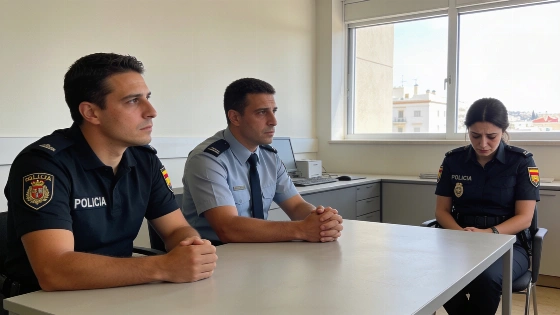
Two Spanish police officers stationed in Algeria have confessed to harassing a colleague. One admitted to sexual harassment. Both avoid prison after a plea deal. The case exposes failures in embassy oversight and internal accountability.
Two Spanish police officers assigned to the embassy in Algeria have admitted to harassing a female colleague over a two-year period. One also confessed to sexual harassment. Both men will avoid prison after reaching a plea deal that sharply reduced their sentences. The National Court approved the agreement, drawing renewed attention to how Spanish institutions handle abuse within their own ranks.
The case began on September 2, 2026, at the Audiencia Nacional. Prosecutors initially sought 9.5 years in prison for one officer and 6 years for the other, accusing them of systematic harassment between 2022 and 2024, both at the embassy and during off-duty meetings. The court has not yet issued the final written sentence, and the outcome remains under public and institutional debate.
The Objective
Prosecutors originally sought six years in prison for each officer. Instead, the officer found guilty only of workplace harassment will serve six months, while the one who also admitted to sexual harassment faces eighteen months. Neither will serve time behind bars.
According to the prosecution, the harassment took place between 2023 and 2024, both inside and outside the Spanish embassy in Algiers. The two officers repeatedly targeted their colleague with verbal and physical abuse. In one incident, one officer pinned the victim against a café wall in Algiers. When she called for help from her superior—who was also her harasser—he dismissed her, saying, "I don’t get involved in abuse cases." The case file describes a pattern of complicity and inaction by the team leader, who was responsible for the mission’s security.
The abuse escalated from crude comments and sexual propositions during off-duty gatherings to direct, demeaning orders when the victim refused to join them. On one occasion, after she declined to attend a late-night meeting, the officer responded with a vulgar command in front of other embassy staff and security team members. The harassment was open, taking place in front of Spanish personnel, including interns and security colleagues.
The Objective
After the café assault, the victim managed to break free and, visibly shaken, sat at a nearby table. The perpetrator then sat across from her, making obscene gestures and comments, while the superior did nothing. A month later, the same officer insulted her in front of another colleague, further cementing the toxic environment.
Despite the victim’s formal complaint to higher authorities in January 2024, both officers were only dismissed from their posts after months of inaction. Earlier, an investigation began after a report from Algerian police to the embassy’s Interior advisor. Instead of protecting the victim, the internal probe penalized her for minor workplace infractions, such as leaving a light on or forgetting a bag. She was repeatedly assigned the most uncomfortable duties and systematically distanced from embassy work, as confirmed by the prosecution’s findings.
This is not an isolated incident. Spanish authorities have faced criticism for their handling of internal misconduct, with recent events—such as the police response to a wildfire in Barcelona province—highlighting broader issues of accountability and transparency within law enforcement and public service.
The National Court is expected to formalize the plea agreement in the coming days. The facts of this case reveal a troubling pattern: not only did the perpetrators avoid meaningful punishment, but the victim was further marginalized by the very system meant to protect her. The willingness of the prosecution and the court to accept reduced sentences, despite clear evidence of sustained abuse and institutional complicity, raises serious questions about the limits of justice when the accused are police officers. Until Spanish institutions address these failures directly, trust in their ability to protect their own personnel—and the public—will remain compromised.