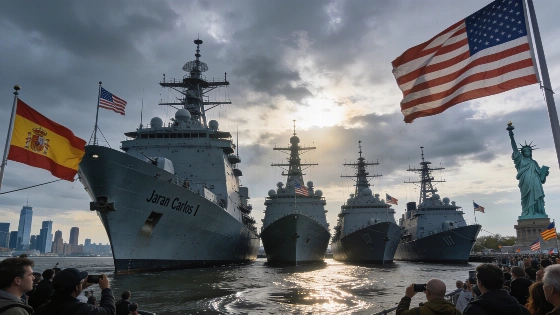
Five Spanish Navy ships took part in the 250th US Independence anniversary in New York. The visit coincided with Donald Trump's threats to cut trade ties with Spain. The deployment highlights Spain's growing role in NATO operations.
Five Spanish Navy vessels, including the flagship Juan Carlos I, docked in New York this week to participate in the 250th anniversary celebrations of US independence. The visit, organized at the invitation of the US Navy, unfolded as former US President Donald Trump renewed his criticism of Spain at the NATO summit in Ankara, threatening to sever trade relations between the two countries.
The Spanish contingent—comprising the Juan Carlos I, the amphibious assault ship Castilla, the frigates Blas de Lezo and Reina Sofía, and the supply ship Patiño—joined the Naval Parade 250 alongside ships from 130 navies and coast guards worldwide. Most of the Spanish ships are scheduled to depart the US on Wednesday, with the Juan Carlos I leaving a day later.
This high-profile Spanish presence in New York stands in stark contrast to recent remarks by Trump, who, during a rally in North Dakota, boasted about the US seizing Cuba, Puerto Rico, the Philippines, and Guam from Spain in the 1898 war after the Spanish fleet was sunk at Santiago de Cuba.
The five ships form the Atlantic Expeditionary Combat Group 26, the largest Spanish naval deployment of the year. Nearly 2,500 military personnel, 75 vehicles, 10 aircraft—including AV8B Harrier jets and helicopters—and 12 amphibious craft are part of the mission. On their way to New York, the group took part in the international FleetEx250 exercise, led by the US Navy. However, their main assignment begins on the return journey, when Castilla will serve as command ship for NATO's Task Force Atlantic, responsible for security in the North Atlantic and Arctic regions.
Only six of NATO's 32 member states can provide a seaborne headquarters capable of leading allied forces. The Spanish deployment is part of Operation Artic Sentry, launched by NATO in February to address security concerns in the Arctic—a region Trump has cited as justification for seeking control over Greenland, an autonomous Danish territory.
Artic Sentry focuses on enhanced surveillance, giving NATO commanders direct insight into a region increasingly accessible due to polar ice melt from climate change. The operation also aims to deter growing Russian and Chinese naval activity in this strategically vital, resource-rich area.
NATO's Joint Command in Norfolk, USA, coordinates allied forces in the region. In recent years, the alliance has expanded its presence with a Combined Air Operations Center in Norway and forward land forces in Sweden and Finland, the newest NATO members. Plans are underway to further strengthen capabilities with icebreakers, drones, and the Northlink Arctic satellite program.
While Spain had not previously participated in Artic Sentry, six Spanish Air and Space Force F-18s were deployed to Keflavik, Iceland, in 2025 to monitor the island's airspace. Additionally, Spanish Army mountain troops joined the Cold Response 26 exercise in northern Norway earlier this year. These activities, according to Defense sources, underscore Spain's commitment to NATO security from the Arctic to the eastern flank, where Spain maintains the largest overseas troop presence among alliance members, despite Trump's ongoing criticism.
Spain's growing involvement in NATO operations comes at a time of heightened scrutiny of allied contributions and security arrangements. The Spanish Navy's participation in high-profile international exercises and command roles reflects a broader trend of increased engagement. In a related development, Spanish authorities recently concluded a decades-long manhunt for a fugitive in Seville province, as detailed in this report on the arrest of a long-sought bank robber. Such cases highlight the diverse range of Spain's security and defense commitments, both at home and abroad.
Spain's naval presence in the US and its leadership role in NATO's Arctic operations illustrate the country's evolving defense priorities. As the Arctic becomes more accessible and strategically contested, Spain's participation in multinational exercises and command structures signals a clear intent to remain a key player in collective security efforts. The ongoing debate within NATO about burden-sharing and regional security is likely to keep Spain's contributions in the spotlight, especially as global tensions and climate-driven changes reshape traditional defense landscapes.