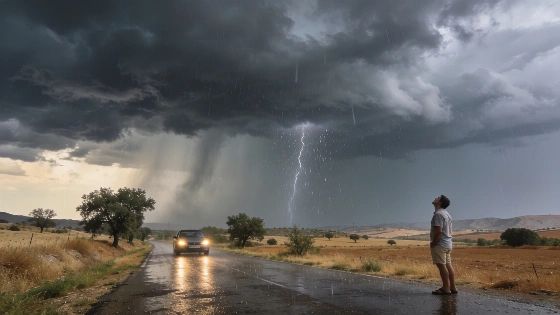
Severe storms are set to hit eastern Spain during the ongoing heatwave. Intense showers, strong winds and hail are expected in several regions. Authorities warn of increased fire risk and unstable weather.
Eastern Spain is bracing for a surge in severe storms as the current heatwave intensifies. From Friday through Saturday, meteorological models predict the rapid development of storm clouds across the Pyrenees, Aragon, Catalonia, Teruel, Navarra, and parts of the Mediterranean coast. These storms are expected to bring intense downpours, strong gusts of wind, and hail, disrupting the stable weather that has dominated much of the country in recent days.
Temperatures have already soared above 40°C in several provincial capitals, with the most significant anomalies recorded in the northern interior. The fourth heatwave of the summer is pushing thermometers to extreme levels, and forecasts indicate that the situation could worsen over the weekend, especially in Mediterranean communities and the Canary Islands. The combination of high temperatures and incoming storm systems is creating a volatile atmosphere, increasing the risk of sudden weather changes.
According to the latest European weather models, storm activity will intensify from midday, particularly in mountainous areas. The Pyrenees, northern Catalonia, Teruel, and Navarra are expected to see the most severe impacts, with locally heavy showers and the potential for hailstones exceeding 2 cm in diameter. In these regions, wind gusts could surpass 50-60 km/h, raising concerns about property damage and public safety. Lesser but still notable showers are forecast for the interior of Castellón, Albacete, the northwest of Murcia, and the eastern Andalusian sierras. Northern Galicia and the Cantabrian slope may also experience isolated storms and showers.
Storm cells in the Pyrenees and Teruel could become more organized, leading to rainfall accumulations above 20 l/m² in some locations. The presence of Saharan dust will further complicate conditions, especially in the south and Balearic Islands, where skies will appear hazy and, in some cases, muddy rain may fall. This dust, combined with smoke from ongoing wildfires, is expected to reduce air quality and visibility. The risk of new fires remains high or extreme across much of Spain, as dry vegetation and lightning strikes from storms create hazardous conditions. Recent events, such as the mass evacuations in Ávila due to wildfire threats, highlight the dangers posed by this combination of heat and unstable weather, as detailed in reports on emergency evacuations in Ávila.
On Saturday, storm activity is set to repeat in many of the same areas. Cumulonimbus clouds will develop again from midday, with afternoon showers likely in Teruel, inland Castellón, eastern Castilla-La Mancha, southern Valencia, the eastern Andalusian sierras, and the Pyrenees. However, rainfall totals are expected to be less significant than on Friday. Isolated hail and strong winds remain possible, and in the southeast, muddy rain may persist due to lingering Saharan dust. Northern Galicia and the Cantabrian region will continue to see occasional showers and storms, while Sunday may bring scattered storm cells to the Pyrenean range and possibly the eastern interior.
Spain's summer weather is increasingly marked by the interplay of heatwaves and sudden storms. The current pattern, with its mix of extreme temperatures, Saharan dust, and unstable atmospheric conditions, underscores the challenges facing both residents and emergency services. The risk of wildfires remains a critical concern, especially as lightning and strong winds can quickly escalate local incidents. For context, Spain has experienced a notable rise in extreme weather events in recent years, with the Mediterranean and northern regions particularly vulnerable to rapid shifts between heat and storms. Authorities continue to monitor the situation closely, urging residents to stay alert for weather warnings and to take precautions against both heat and severe storms.