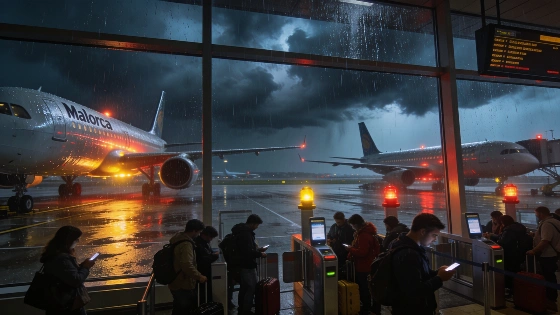
Severe weather in Mallorca has led to over 200 delayed flights and multiple cancellations at Palma airport. Menorca and Ibiza airports continue normal operations as storms bypass these islands.
Operations at Palma's Son Sant Joan airport faced significant disruption today as intense storms swept across Mallorca, forcing airlines to delay or cancel numerous flights. By late morning, Aena reported that 208 flights were running behind schedule, split evenly between departures and arrivals. The situation remained tense into the early afternoon, with 203 flights still delayed and 13 cancellations confirmed, highlighting the scale of the impact on both travelers and airport staff.
While Palma struggled with the fallout from the adverse weather, airports in Menorca and Eivissa maintained normal schedules. According to Aena, these neighboring islands were spared from the worst of the meteorological episode, with no operational incidents reported so far. The contrast underscores how localized weather patterns can sharply affect air travel in the Balearic archipelago.
The day began with Mallorca under a weather alert for heavy rain and thunderstorms, though the warning level was downgraded to yellow as conditions evolved. The State Meteorological Agency (Aemet) warned that rainfall could reach up to 25 liters per square meter within an hour, and did not rule out the possibility of hail. Such forecasts prompted airlines and airport authorities to adjust operations, prioritizing safety amid rapidly changing conditions.
Disruptions of this scale are not unprecedented in Spain, where extreme weather events have increasingly affected transport infrastructure in recent years. For example, a recent wildfire near Madrid led to mass evacuations and highlighted the vulnerability of critical services to sudden shifts in weather. While the current situation in Mallorca centers on rain rather than fire, the operational challenges for airports and emergency services remain comparable.
Flight delays and cancellations can have a ripple effect on tourism and local economies, especially during peak travel periods. Mallorca, as one of Spain's most visited destinations, relies heavily on efficient air connections. Weather-related disruptions not only inconvenience passengers but also strain resources at airports and airlines. According to Aena, real-time updates and contingency planning are essential to minimize the impact of such events. Travelers are advised to check flight statuses regularly and allow extra time for airport procedures during adverse weather conditions.
Spain's airports are accustomed to handling a high volume of seasonal traffic, particularly in the Balearic Islands. However, episodes like today's storms in Mallorca serve as a reminder of the unpredictability of weather and the importance of robust response protocols. As climate patterns continue to shift, authorities and operators may need to further adapt their strategies to ensure passenger safety and operational resilience.