Pedro Sánchez calls the Supreme Court's precautionary measures very serious. The decision affects voters who gained Spanish nationality through the Ley de nietos and registered abroad.
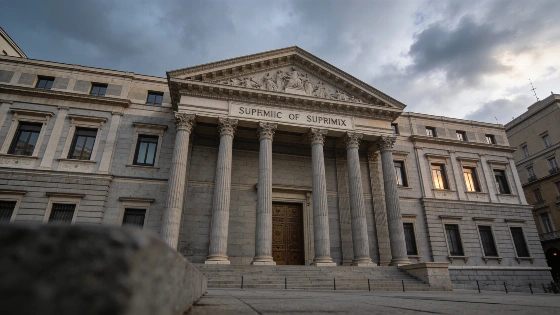
The Supreme Court has provisionally halted voting rights for some Spanish citizens who obtained nationality through the Ley de nietos. The measure affects people already listed in the Censo Electoral de Residentes Ausentes (CERA) who have not proved that their ancestors went into exile for political reasons. Pedro Sánchez called the decision very serious and said it undermines democracy.
The dispute now centres on the overseas electoral register. The question is whether recently nationalised citizens can vote in the next election. Sánchez said the courts had stopped a rule that secured voting rights for 400,000 new Spaniards living abroad. That figure gives the decision an immediate political impact.
La Junta Electoral Central исполнила распоряжение Верховного суда, одновременно заявив о споре вокруг своих полномочий и влиянии решения на избирательный реестр.
The prime minister made the remarks in Gavá during the closing event of the traditional Fiesta de la Rosa, organised by the Partido Socialista de Cataluña. He said he would not challenge the Supreme Court's decision, although he disagrees with it. He added that the court must now resolve the issue.
The court accepted the precautionary measures after an appeal by PP and Vox. Their practical effect is to suspend voting rights for people already listed in CERA who have not provided the required evidence of political exile. Reports from RTVE and Politico identify Vox and Iustitia Europa as the parties behind the challenge, rather than the government.
The numbers show why the register is at the centre of the dispute. A total of 333,696 descendants have enrolled in the CERA census, while 571,000 applications have been approved. The source material does not establish that all of these people are affected by the suspension. It identifies the restriction specifically for registered voters who lack the required proof.
Решение не отменяет уже полученное испанское гражданство и касается только права голоса в CERA. По данным CNN en Español, сохранить возможность голосовать могут те, кто подтвердит, что является ребёнком или внуком испанца, пострадавшего от изгнания по политическим, идеологическим или религиозным причинам либо из-за сексуальной ориентации или гендерной идентичности.
Ángel Víctor Torres accused the Supreme Court of changing the census through its decision. The socialist politician from the Canary Islands said nobody can know how the newly registered voters will cast their ballots. He also argued that the census changes when eligible citizens are stopped from voting, not when they use that right.
His argument points to the political uncertainty created by the case. Descendants of exiles do not form a predictable voting bloc simply because they share a route to Spanish nationality. As Torres said in substance, nobody can know the political position of an exile's child in advance.
According to THE OBJECTIVE this week, the dispute centres on the evidence needed to link applicants to politically motivated exile. That condition now determines whether some people who have completed the nationality process can use the voting right connected to it.
The government's position is clear. The Supreme Court's intervention has interrupted the electoral effect of the Ley de nietos for part of the overseas register, while the court process continues. RTVE reports that more than 400,000 people have obtained Spanish citizenship through the procedure. That helps explain the political sensitivity of the dispute.
The restriction is temporary and will remain in force until a final decision is issued. It is not a final ruling on the merits of the case.
This is not a minor administrative dispute. It concerns the voting rights of people listed in a register created for Spaniards living abroad. It also involves hundreds of thousands of descendants and approved applications.
The figures show the scale of the electoral change sought by the Ley de nietos. The court's measure shows that access to the ballot remains conditional for people who cannot document the required exile history. Based on the available facts, the government has a strong political objection but no authority to override the court. The Supreme Court's pending decision is therefore the next step for the affected voters.