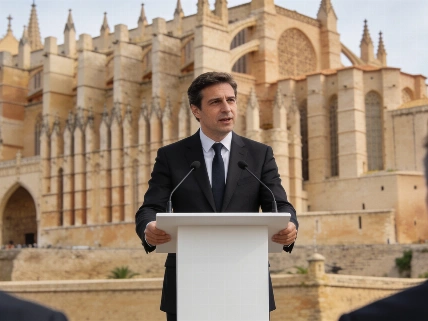
Telefónica is reshaping its Spanish business around three commercial units. Movistar Plus will lose its separate board and report directly through B2C España.
Javier de Paz will leave the non-executive chairmanship of Movistar Plus as Telefónica changes how its Spanish business is run. The television platform will move directly into B2C España under Óscar Candiles. Several support functions will also come under Marc Murtra's direct control.
El País and El Periódico describe the plan as an attempt to cut management layers and speed up decisions in Spain. Telefónica's board reviewed and approved the reorganisation. The company also prepared it as a corporate decision for communication to the CNMV.
Telefónica’s board reviewed and approved the Spanish reorganisation, which was also prepared as a corporate decision to be communicated to the CNMV.
The change removes the board of Telefónica Audiovisual Digital. De Paz will leave the non-executive chairmanship of Movistar Plus, but he will stay at Telefónica as deputy to the chairman.
His revised duties will cover Development and Business Continuity in the European area. They will also include Infrastructure, Real Estate Assets and Corporate Social Responsibility.
The board met about four times a year. Manuel Pizarro, Yolanda Barcina, Marius Carol, Gerard Guiu, Daniel Clivillé and Andoni Ortuzar were among its members.
This is a governance change.
Movistar Plus will sit inside the structure responsible for residential customers. The platform will no longer have a separate governance forum.
Telefónica's Spanish operation will now have three commercial units. B2B España will be led by Borja Ochoa. B2C España will be led by Óscar Candiles. Marisa Urquía will lead Mayorista España.
B2B España will handle business and public administration customers. B2C España will bring together residential services, connectivity, television, hardware, devices and Movistar Plus content. Mayorista España will continue its relationships with other operators.
Spanish business publications had already reported the three-part model. The structure puts consumption, companies and technology at the centre of the Spanish operation.
The new structure is intended not only to reduce internal layers but also to concentrate Spanish decision-making around residential customers, corporate and public-administration clients, and wholesale relationships. Analysts and business publications also see the model as a possible platform for taking Telefónica Tech’s services to other European markets.
Ochoa will also keep the non-executive chairmanship of Telefónica España. His unit will absorb Telefónica Tech and will expand services in cybersecurity, cloud, data and artificial intelligence, the Internet of Things and defence and security solutions across other European markets.
Sofía Collado will continue to lead Telefónica Tech.
Sergio Sánchez will head CTIO España. The unit will cover Telefónica's network, systems and operations in Spain.
Telefónica says it wants to simplify and change these processes through automation and artificial intelligence. The company will not keep separate structures for functions that overlap.
The consolidation reaches beyond the commercial units. Finance and Control, Strategy, People, Legal, Security and Audit were previously divided between the Spanish subsidiary and the parent company. Those support areas will now join the corresponding corporate departments under Murtra's direct authority.
The stated goal is simple: remove duplication, simplify procedures and speed up decisions.
The redesign is part of the second stage of the Transform & Growth strategy. Telefónica has already changed the group's perimeter by selling most of its Latin American subsidiaries.
Venezuela is the remaining divestment. Market sources describe that process as complex because of the country's political situation.
The Spanish redesign comes with a change to the company's registered address. Telefónica is moving it from 28 Gran Vía in Madrid to Ronda de la Comunicación in Las Tablas, where Distrito Telefónica is located.
The board approved the move unanimously. It also authorised the related amendment to the company's statutes.
The address change follows the sale of the historic Gran Vía building to Murcian businessman Tomás Olivo for just under 200 million euros. Telefónica will not leave the property at once. It will rent several floors for at least three years.
Fundación Telefónica and Espacio Movistar will remain there for the time being. The Spanish corporate agenda also includes an earlier housing report, but that matter is separate from Telefónica's management and operating changes.
Telefónica is replacing its layered Spanish model with three accountable business lines and one operational technology structure. Movistar Plus will now be managed as part of the residential relationship.
Fewer layers. More direct control.