Telefónica is rebuilding its German O2 business around artificial intelligence. The plan includes 150 AI applications, staff cuts and 60 store closures as the company seeks new growth.
In January, Santiago Argelich Hesse took charge of Telefónica Deutschland after Markus Haas left the chief executive role. He now faces a sharp reset at the German company behind the O2 brand. The plan covers 150 artificial intelligence applications, 1,100 job cuts in 2026 and the closure of 60 company-owned stores.
The pressure began with the loss of 1&1. The rival operator stopped renting O2's mobile network and moved to Vodafone's network. Telefónica Deutschland lost as much as €500 million in annual revenue. Sales fell 3.8% in 2025 and another 9.8% in the first half of 2026. Company materials and independent market reports put 2025 revenue at €8.2 billion.
Telefónica Deutschland reported revenue of €8.2 billion for 2025, providing a scale for the German business now being reshaped after the loss of 1&1.
The 1&1 effect should stop distorting comparisons from 2027. Until then, the German unit must absorb the commercial damage. It also has to cut costs and find new sources of growth.
Argelich Hesse has moved quickly. He wants a simpler organisation and says modern AI systems can cut the complexity of processes and internal systems. Reuters has also identified him as the new head of Telefónica Germany as the business adjusts to 1&1's move to Vodafone.
O2 is already using the technology in network management. That work has cut energy use by 10%. Other applications cover customer self-service, personalisation and faster internal processes. The company is using AI across the organisation, not only in customer-facing services.
Market analysts increasingly view 2027 as the point at which the impact of 1&1 will be easier to separate from Telefónica Deutschland’s underlying performance. That makes the year an important test of whether the restructuring has restored a basis for renewed growth, rather than merely reduced costs.
The plan has a direct human cost. O2 agreed this summer to a restructuring plan affecting about 1,100 employees. That equals 16% of its workforce of roughly 6,800 people. Telefónica Deutschland has set aside €265 million for the programme.
More cuts may follow. Sales and customer service will be consolidated further in 2027 and 2028. Total departures could reach around 1,600 employees.
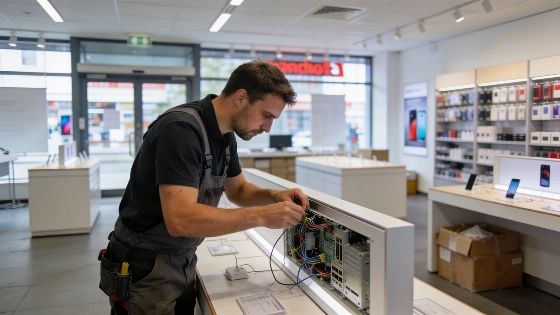
The retail network is shrinking. O2 will close 60 of its 800 company-owned stores as more customers use digital channels.
Fixed-line services remain a weak spot. Telefónica Deutschland owns very little fixed infrastructure. It does not plan a large fibre rollout because construction in Germany is slow and expensive. Fibre currently reaches 50% of the population. That makes access agreements with Deutsche Telekom, Vodafone and newer fibre operators central to O2's broadband offer.
Argelich sees a faster route in business and public-sector contracts. O2 holds less than 5% of that market, which Telekom and Vodafone dominate. It has already won 2026 contracts with major German retailers, including Deichmann and JYSKS. The company also wants a larger wholesale role through Aldi Talk, whose mobile service has almost 10 million customers.
O2 plans to present its existing brand as premium. A new brand would target the middle segment. The proposed portfolio covers mobile and fixed services, television, security and other digital products.
A takeover of 1&1 is not part of the current plan, according to the CEO. He has not ruled out examining opportunities. He believes Germany's market is stronger with three operators rather than four. 1&1 faces major network rollout commitments in a market that is not expected to grow. Its value has doubled since 2025 to about €4.3 billion amid consolidation speculation.
The numbers explain the interest. O2 held 6.4% of Germany's broadband market in 2025. 1&1 held 10.7%. Together, they would reach 17%. Vodafone held 27% and Telekom 40%.
The reset is bigger than an AI project. Telefónica Germany is moving away from wholesale dependence and toward tighter operations and selective growth. AI may improve efficiency. O2 still has to repair its network position, replace revenue lost after 1&1 and make painful staffing decisions. The underlying growth will be judged in 2027.