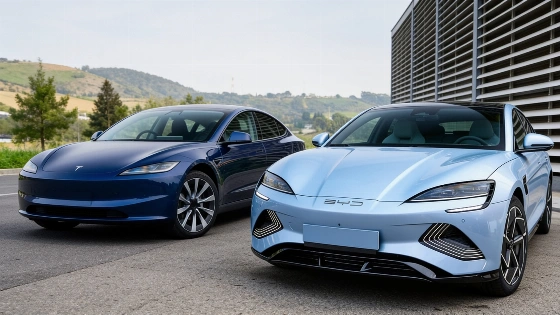
In September, no European marque appeared among Spain’s 10 best-selling electric cars. Tesla and Asian manufacturers lead the rankings. European brands have faded from view as shifts in buyer preferences reshape the market.
The numbers tell the story. Tesla Model 3 leads by a wide margin, with 1,723 new registrations. It outsold every other electric car, as well as the most popular petrol and hybrid models. Toyota Corolla and Toyota C-HR, which usually top Spain’s overall sales rankings, recorded 1,082 and 1,029 registrations. The Model 3 surge is no fluke: whenever new Tesla shipments arrive in Spain, the brand jumps ahead. Fresh industry data also show a strong contribution from Model Y, with between 638 and 715 registrations, depending on the reporting period. That underlines how heavily Tesla’s month-end deliveries can influence the results.
Leapmotor B10, assembled in Zaragoza, has led Spain’s electric C-SUV segment for several consecutive months.
The biggest surprise, though, is lower down the list. As of September 18, no European manufacturer had broken into the top 10 for electric-car registrations. Chinese brands took six of the 10 spots. Tesla and Toyota claimed two more, while KIA filled another. Leapmotor B10, a Chinese model now assembled in Zaragoza, followed two Teslas with 209 registrations. Japan’s electric Toyota C-HR+ recorded 193, while the Chinese BYD Dolphin Surf had 190. KIA EV3, the only non-Chinese Asian car near the top of the ranking, recorded 132 registrations.
BYD has secured a strong position in the rankings. The BYD Atto 2 and Atto 3 Evo recorded 125 and 123 registrations. Changan Deepal S05 rounds out the Chinese contingent with 102 cars. Leapmotor also put a second model, the B05, among the leaders. That means Chinese cars account for six of Spain’s 10 best-selling electric vehicles this month, with no European marques among the leaders. Leading automotive publications describe this as a turning point. Leapmotor and BYD are setting the pace, with Changan/Deepal now doing the same in Spain’s market.
European hopes were pinned on Renault 5 E-Tech, but it has so far managed just 75 registrations. Renault has focused on France, where demand is higher, leaving Spanish buyers waiting. Volkswagen, until recently Europe’s electric-car leader, has failed to reach Spain’s top 10. Its best result was 58 registrations for Volkswagen ID.4. That contrasts sharply with 2025, when Volkswagen overtook Tesla in European electric-car production. Spain has yet to see that advantage.
Industry reviews report that fully electric cars accounted for 9.6% of new registrations in Spain in the first half of 2026, making the country one of Europe’s fastest-growing EV markets. That rapid growth is adding pressure on traditional manufacturers to adapt faster.
New competitors are entering the market. Geely E2, China’s best-selling car across all vehicle types, is now coming to Europe. The company hopes to repeat its success here. The picture could change before the end of the month, but for now Tesla and Asian brands are setting the pace as European giants try to hold on to what influence they have left.
Why are Spanish buyers turning away from European electric cars? Price is the basic reason. Chinese models appeal through value for money, not technology or luxury. European brands have failed to match that balance. Buyers want a clear deal, not complicated configurators and inflated prices. Tesla keeps things straightforward: an online configurator and clear prices before and after subsidies, without confusing choices between petrol, hybrid and electric models. European marques, by contrast, often burden customers with complex options and high starting prices, cut only through occasional promotions. Many buyers are put off by the upfront cost and never reach the point of purchase. Recent analyses show that some Leapmotor, BYD and Renault electric cars are currently advertised in Spain for less than 15,000 euros after discounts and government support. That is adding pressure on European brands in the mass-market segment.
Spain’s market is shifting quickly toward Asian and American electric cars. European manufacturers are in a difficult position and losing ground because they cannot compete on price or customer convenience. Buyers expect clear pricing and affordability; manufacturers that cannot deliver risk being left behind. In a country already grappling with trust and transparency in the car market, as reported earlier, the rise of simple, affordable electric cars is a new reality European brands can no longer ignore.