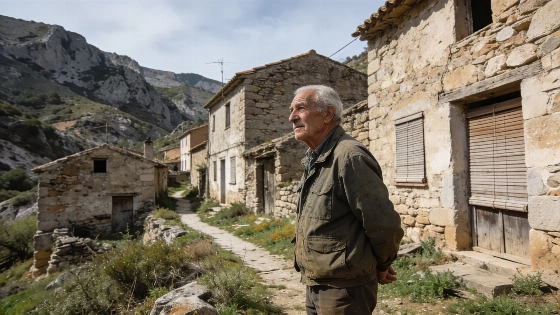
Paco, nearing 70, is the sole inhabitant of a remote Jaén hamlet, caring for abandoned houses and surviving harsh winters. His story highlights the deepening population crisis in rural Spain and the realities of life on the edge of depopulation.
Paco’s daily routine unfolds in near silence. In a small, unnamed hamlet perched 1,200 meters above sea level in the Sierra de Segura, he is the only permanent resident among 14 shuttered houses. When RTVE filmed him in April 2022 for Comando Actualidad, Paco was approaching 70 and had spent his life in this isolated corner of Santiago-Pontones, Jaén. The village’s school, shop, blacksmith, and seamstress are long gone, their buildings now relics of a vanished community. The old wood-fired oven stands half-buried in debris, and the traces of families who left the mountains remain in the locked doors and empty rooms.
As the sole inhabitant, Paco takes on every role: caretaker, watchman, and unofficial mayor. These are not formal titles, but a reflection of the reality that every responsibility falls to him. He maintains the houses, monitors the surroundings, and handles daily chores alone. Most former residents moved to Catalonia or the Valencian Community when work dried up, leaving Paco to face winters where temperatures can drop to minus 20°C and snow can cut off the hamlet for weeks.
Surviving Isolation
With the nearest supermarket 30 kilometers away, Paco plans his shopping trips carefully, stocking up once a month. His home is equipped with preserved meats and a large freezer, ready for storms that might trap him for days. Some food comes from his land or is bartered with people in other villages. This self-sufficiency echoes the habits of earlier generations, who stored supplies for even longer periods.
Not far away, another solitary resident, Javier, lives several kilometers down an unpaved track. His house runs on solar panels and spring water. During the Filomena blizzard, Javier was cut off for 19 days, describing the experience as the hardest of his life. Both men value the peace and security of their environment, but acknowledge the high costs of fuel, frequent breakdowns, and deteriorating roads.
Population Collapse
Paco’s situation is part of a broader demographic crisis. According to the INE, Santiago-Pontones had 5,021 residents in 1996; by 2025, that number had fallen to 2,629—a 47.6% drop in less than three decades. The decline has accelerated, with a 21.2% decrease in just the last ten years. The municipality covers 684 square kilometers, but its population density is now just 3.8 people per square kilometer, scattered across nearly a hundred hamlets within the Sierras de Cazorla, Segura y Las Villas Natural Park. This extreme dispersion makes it difficult to maintain roads, communications, and basic services. In 2025, the regional government officially listed Santiago-Pontones among Andalusia’s most depopulated municipalities. Local initiatives, such as supporting livestock farmers, aim to keep rural life viable, but the challenges are steep.
Choosing Solitude
Paco does not see his life as a sacrifice. He values the quiet, the safety, and the freedom to leave his door unlocked. “I chose to stay because I love nature,” he says. Yet he is clear-eyed about the future: “When I’m gone, the village will be gone too.” His story illustrates that depopulation is not just about numbers—it means losing immediate help, facing higher costs for services, and watching local heritage fade without successors. Efforts to revive abandoned villages elsewhere in Spain show that reversing this trend requires more than nostalgia; it demands housing, jobs, connectivity, and public investment. In Santiago-Pontones, the Junta has allocated €250,000 in 2026 for road and path maintenance as part of a pilot program.
While Paco’s current status is unconfirmed in 2026, his experience remains a stark example of rural Spain’s demographic decline. Stories of resilience and adaptation, like his, echo the journeys of others who have chosen to remain in places most have left behind. For instance, the determination to build a new life in challenging circumstances can be seen in those who, after arriving in Spain under difficult conditions, have managed to establish themselves and contribute to their communities, as described in this account of Moha’s path from Guinea to Almería.