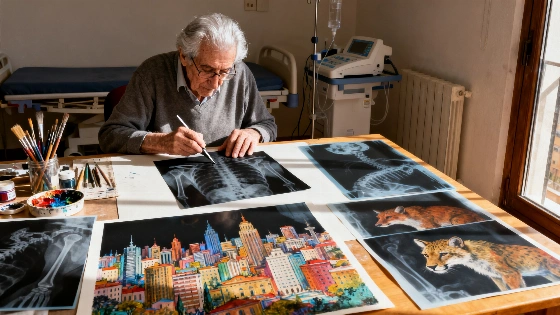
For 50 years, José Antonio Mateo has transformed discarded X-rays into striking works of art using only a scalpel and steady hands. His rare method, developed in Madrid, is now on display in his own neighborhood.
On a quiet street in Madrid's Valdezarza district, 90-year-old José Antonio Mateo spends his days hunched over a black X-ray, scalpel in hand, coaxing images from darkness. For half a century, Mateo—known simply as Mateo—has practiced a technique so unusual that even he struggled to name it. Today, his collection of over 600 works stands as a testament to patience, precision and a lifetime of quiet innovation.
Mateo calls his method "grapel," a blend of "grabado" (engraving) and "película" (film). The process began with a moment of curiosity at the hospital where he worked as an electronics technician. Passing by stacks of discarded, fully blackened X-rays, he wondered what would happen if he scratched their surface. The result was a spectrum of tones, depending on the pressure applied—a discovery that would shape the next five decades of his life.
From Zamora to Madrid
Born in Puebla de Sanabria, Zamora, in 1936, Mateo's early years were marked by upheaval. He lost his father during the Spanish Civil War and spent his childhood moving between relatives in Galicia, León and Extremadura. Later, he sought work in France and Germany before settling in Madrid, drawn by the promise of employment.
His professional life was rooted in electronics. Mateo repaired radios, televisions and transistors, and was among the first in his field to join Spain's Social Security system. Eventually, he found work at Hospital Universitario La Paz, maintaining monitors in intensive care and cardiac units. When his supervisor moved to the newly built Hospital Universitario 12 de Octubre, Mateo followed, overseeing the distribution of electronic equipment across departments.
The Birth of Grapel
It was in the hospital's radiology department that Mateo's artistic journey began. Surrounded by blackened X-rays, cardboard and surgical scalpels, he experimented by scratching the film. He soon realized he could control the intensity of each mark, developing a scale of 17 distinct tones—12 in the emulsion layer and 5 in the plastic base. The technique required not only a steady hand but also the ability to "think in reverse": every stroke removed material, revealing light from darkness.
"You need a very steady hand, to think backwards, and infinite patience," Mateo says. Some pieces took him up to nine months to complete, with no room for error—once a mark is made, it cannot be undone. In five decades, he claims to have ruined only one work.
Inside the Creative Process
Each artwork begins with a detailed pencil sketch on cardboard. Mateo then transfers the design onto the X-ray, carefully matching each area to the right tone. The process is unforgiving: starting from a black background, he gradually removes layers to reveal the image. Most pieces take about a month, but the most complex can require much longer.
Among his most ambitious works are large-scale depictions of the Plaza del Obradoiro in Santiago de Compostela and the Acueducto de Segovia, each over two meters tall and composed of multiple X-rays. Over the years, Mateo has collaborated with companies like Kodak and Fujitsu, who have exhibited his works at international symposia in cities such as Tokyo and New York.
Exhibition in Valdezarza
Until June 26, a selection of Mateo's works is on display at the Parroquia Cena del Señor, just across the street from his home. The choice of venue is personal: a decade ago, his art adorned the church's walls, and this time he dedicates the exhibition to his neighbors and friends. The show features architectural scenes, animals and even the solar system. Some subjects, like nudes, are omitted out of respect for the setting.
Visitors are encouraged to look beyond the finished image and appreciate the process—each shade is the result of a different pressure, each detail the product of hours of careful work. In an age of digital shortcuts, Mateo's art stands as a reminder of the value of craft and patience.
Why He Refuses to Sell
Despite receiving offers for his pieces, Mateo refuses to put a price on his art. "People tell me I could make a lot of money, but I don't want to. I have enough to eat, a house in the country and an apartment by the sea. What more could I want?" he says. For him, the value is personal—his two children come first, but discovering this technique, he says, has been the most important thing in his life after family.
Thanks to his collaborations, Mateo has never lacked for materials; companies have supplied him with boxes of X-rays in exchange for his participation in exhibitions. As he approaches a century of life, his work continues to draw quiet admiration, both for its technical mastery and for the singular vision behind it.