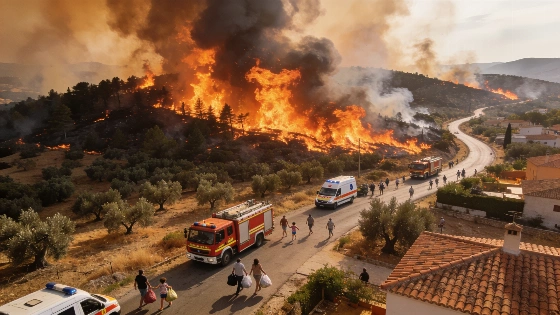
Authorities declared a critical emergency in Castellón after flames put 19 municipalities at risk and sent 16,000 residents from their homes. During the emergency, the fire was reported to have consumed 4,300 hectares, prompting overnight evacuations and the relocation of families to temporary shelters. The blaze began on 25 July 2026 in southern Castellón and was later identified by RTVE as the Vall d’Uixó fire.
In Vall d’Uixó, police began evacuations in the early hours, knocking on doors and telling residents to leave immediately. Many, including Sarai Sánchez and her partner, Pedro López, had only minutes to decide what to take. Their dog and rabbit were impressive. The local sports center in Moncofa became a temporary shelter for 240 people, while thousands sought refuge elsewhere.
Residents described scenes of anxiety and haste. José Carlos Martos refused to leave without his dog, Roky, and worried about his home after leaving his phone behind in the rush. Luis Segarra and his wife, Virginia, from Alfondeguilla, spent a tense night hoping the fire would not reach their house. Neighbors such as Enrique Insua, who works in agriculture and construction, also faced uncertainty. TVE journalist Gemma Guzmán and her family evacuated with their children after receiving an emergency alert.
For many, the fire brought back painful memories. Francisco Doñate, a local hunter and ceramics worker, recalled a similar disaster in the 1980s that devastated the region and took years to recover from. As flames threatened the mountainous field, residents feared a repeat of that history.
Emergency services set up a command post 10 kilometers from the basic shelter, coordinating 450 personnel and 20 aircraft in the firefighting effort. Officials were also concerned about the so-called “rule of three 30s”: temperatures above 30 degrees Celsius, winds exceeding 30 kilometers per hour and humidity below 30 percent. Together, these conditions can sharply increase fire intensity and make containment more difficult.
The first night at the Moncofa shelter was relatively calm, with local officials reporting only minor medical incidents. But the scale of the evacuation and the continuing threat left residents anxious about when they could return and what they would find. RTVE’s October 19 retrospective put the evacuation total at about 16,000 people across 18 municipalities. The emergency account, by contrast, described evacuations and fire threats across 19 municipalities.
RTVE later reported that the fire ultimately burned close to 10,000 hectares, making it the third-largest wildfire in the Valencian Community over the previous decade. That retrospective figure came after the 4,300-hectare estimate reported during the active emergency. Authorities later determined the fire had been deliberately started. Nearly three months after it began, investigators were still trying to identify the person responsible.
The blaze unfolded during an exceptionally demanding week for Spain’s firefighting services. Reporting based on data from the Ministry for the Ecological Transition and the Demographic Challenge said Spain declared Operational Situation 3 during 24-30 July, with Castellón among the provinces most affected. The Unidad Militar de Emergencias took command in some of the worst-hit areas. International assistance came from Greece, Italy, Portugal, Serbia, Türkiye and France. All available BRIF wildfire brigades were deployed, 42 bases were operating, and nearly 20 percent of the firefighting aviation campaign’s flight hours were recorded in that single week.
By 4 October, ministry figures cited in reporting by Infobae recorded 280,079 hectares burned across 8,635 incidents nationwide, 140 percent above the decade average but 14 percent below the corresponding 2025 total. Spain’s firefighting aviation system had logged more than 10,000 flight hours and 50,259 water drops. These figures place the Castellón emergency within a season that put large pressure on firefighting resources across the country.
Wildfires recur in Spain, particularly during periods of high temperatures and low humidity. Castellón’s mix of rural communities and forested areas leaves settlements exposed to fast-moving fires. The Vall d’Uixó blaze brought the consequences into sharp focus for residents: rapid evacuation, prolonged uncertainty and an investigation that continued after the immediate emergency had passed.