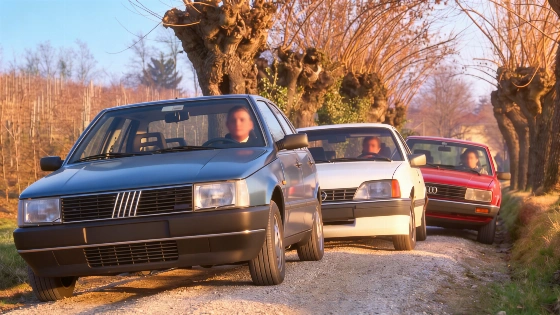
Fiat Croma, Opel Rekord and Volkswagen Passat: The Battle for the Best Family Car of the 80s. In the 1980s, Fiat Croma, Opel Rekord and Volkswagen Passat competed for the attention of family drivers. Why did these particular models become symbols of their era, and how were they compared to each other? We break down an editorial duel from the archives.
In the mid-1980s, a fierce battle unfolded in the European market for a place in the hearts of family drivers: the Fiat Croma, Opel Rekord, and Volkswagen Passat found themselves in the spotlight when the question was not only about practicality, but also about prestige. These three sedans became symbols of an era when the middle class sought not just transportation, but confidence on every trip and a sense of status.
The Fiat Croma emerged as the result of a unique alliance: Fiat/Lancia, Saab, and Alfa Romeo joined forces to create a universal platform for several models. The Italian sedan received not just a distinctive silhouette but also technical features closely related to the Saab 9000. At the same time, the Croma stood out with its spacious interior and rich equipment for its time: electric windows, central locking, folding rear seats, and even a diagnostic display on the instrument panel.
Technical changes
Fiat Croma’s transition to front-wheel drive was an important step: engineers abandoned the classic rear-wheel layout to improve handling and safety. While Ford, Opel, BMW, and Mercedes still held on to traditional designs, the Italians bet on modern solutions. As a result, the Croma handled confidently even at high speeds and didn’t startle the driver with unexpected reactions in corners.
Despite its restrained design, the Volkswagen Passat remained a benchmark for comfort and balanced suspension. German engineers aimed to approach Mercedes standards, and this was evident in its smooth ride. The Passat was practical rather than luxurious—its strength lay in reliability and versatility. The Opel Rekord, on the other hand, looked more conservative: rear-wheel drive, classic architecture, and simple trim. However, the Rekord’s suspension offered a rare balance, and its 2.2-liter engine with Bosch injection enabled it to keep up with competitors.
Engines and character
Each model had its own approach to dynamics. The Fiat Croma featured a two-liter engine with injection and dual camshafts—this engine was refined and quieter compared to its predecessors. The Opel Rekord received an enlarged 2.2-liter engine, which allowed it to hold its own against more modern rivals. The Volkswagen Passat stood out with a five-cylinder Audi engine, delivering excellent highway pull and making the Passat a versatile choice—from an economical version to a powerful and comfortable option.
While Fiat focused on technology and equipment, Opel remained true to tradition, and Volkswagen offered a balanced mix of practicality and comfort. This approach allowed every buyer to find their ideal among these three models.
Who set the tone
A comparative test showed that competition in the family sedan segment of the 1980s was intense, and German manufacturers held their ground. Reliability and proven solutions remained the strong points of Opel and Volkswagen, but the Fiat Croma managed to challenge them with fresh ideas and a high level of equipment. The Italians proved they were capable of creating not only compact cars but also serious contenders in the mid-size class.
Interestingly, decades later, the struggle for innovation and status in the automotive world continues. For example, the launch of the Cupra Raval with fast charging and localized production in Spain has become a new challenge to the established standards — you can read more about this in the article on the launch of Cupra Raval to the market.
Today, the Fiat Croma, Opel Rekord, and Volkswagen Passat remain an important part of European automotive history. Their rivalry in the 1980s shaped customer expectations and set standards that continue to influence family car choices to this day.