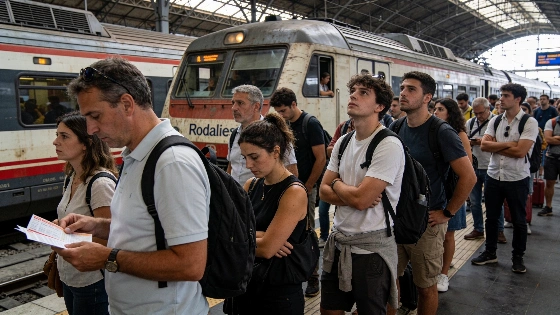
Foreign tourists in Catalonia encounter old trains, ticketing problems and delays on Rodalies. Summer travel exposes weaknesses in the regional rail system. Overcrowding and technical failures disrupt journeys to coastal destinations.
Summer travel in Catalonia has highlighted persistent weaknesses in the Rodalies rail network, as thousands of foreign tourists rely on the system to reach popular coastal towns and beaches. Visitors from the United States, Portugal, China and the Netherlands have reported a mix of outdated trains, confusing ticketing processes and frequent delays, contrasting sharply with their experiences in other countries.
At Barcelona’s Sants station, international travelers described trains as noisy and visibly worn, with several noting the system’s age. For some, like a group of Chinese students attending a Spanish course in Madrid, the condition of the trains stood out immediately. While they found buying tickets at the station straightforward, attempts to purchase online were met with technical errors and higher prices, forcing them to adjust their travel plans.
Portuguese tourists Maria Ângela and Miguel Ventura faced similar challenges. After repeated failures to buy tickets online for their family trip from Lisbon, they discovered that in-person purchases were not only more reliable but also significantly cheaper. The couple expressed surprise at the size of the Catalan rail network but found navigation difficult, especially with limited staff assistance at major stations.
Travelers from the Netherlands, accustomed to seamless digital payments, were struck by the lack of contactless options at Rodalies turnstiles. While ticket prices were lower than in their home country, the inability to use bank cards or mobile apps for entry was a notable inconvenience.
These issues come as Rodalies faces one of its most difficult years. The network has suffered a series of incidents, including the fatal Gelida accident in January, which triggered months of disruptions, delays and a sharp drop in passenger numbers. According to Renfe data, January saw a 31.6% decrease in ridership compared to the previous year, with nearly half of trains failing to meet scheduled times and average delays exceeding 22 minutes.
Recent events have only intensified the strain. During the much-anticipated solar eclipse, both the Generalitat and Servei Català de Trànsit urged the public to use trains for travel to southern Catalonia. However, technical failures led to overcrowded platforms at key stations, echoing the situation described in reports of severe congestion at Tarragona after the eclipse.
Despite these setbacks, some tourists from countries where car travel dominates, such as the United States, expressed appreciation for the ability to explore Catalonia by train. For them, the convenience of public transport outweighed the system’s shortcomings, though the contrast with local users’ frustrations was clear.
Catalonia’s tourism sector, which accounts for around 12% of regional GDP and 13% of employment, remains heavily dependent on reliable transport. The ongoing challenges with Rodalies risk undermining visitor satisfaction during peak travel periods. While the network’s extensive reach is an advantage, persistent technical and operational problems continue to affect both residents and the millions of tourists who pass through each year.
Spain’s regional rail systems, including Rodalies, are managed by Renfe and Adif, with ongoing debates over funding, modernization and transfer of control to local authorities. The Catalan government has repeatedly called for greater investment and autonomy to address chronic infrastructure issues. As international tourism rebounds, the ability of Rodalies to deliver consistent service will remain a key test for the region’s transport policy and its reputation among visitors.