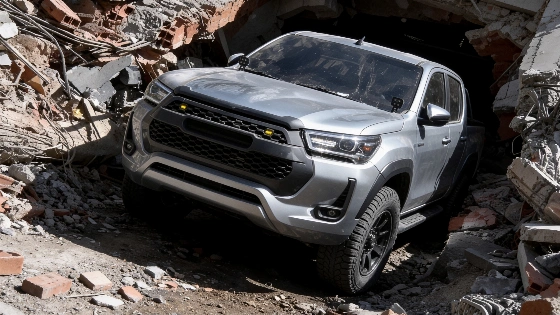
Rescue teams in Colombia made a striking discovery as they cleared debris from a collapsed building after the country’s 7.4-magnitude earthquake. The quake struck on 10 August 2026, with its epicenter near San José del Palmar in the department of Chocó, at a depth of about 103 kilometers. Shaking was felt across 16 departments. Amid shattered concrete and twisted metal, a Toyota Hilux pickup was found almost entirely intact, its bodywork covered by only a thin layer of dust. The vehicle had been parked inside the building when the quake hit, and the structure’s collapse shielded it from the worst of the falling debris.
Footage of the Hilux being driven out of the rubble spread across social media, drawing attention to the contrast between the vehicle and the destruction around it. The earthquake has been described as Colombia’s strongest recorded in the 21st century. About 1.5 million people experienced shaking near intensity 7, while damage to buildings and infrastructure hampered rescue and recovery work. The pickup appeared ready to return to service, a striking outcome amid the destruction.
Information from those involved in the recovery, the Hilux’s survival was largely a matter of luck. Had heavy debris struck the vehicle directly, it would likely have suffered impressive damage. Instead, the building’s collapse created a protective pocket, sparing the chassis and bodywork from serious harm. Volunteers spent hours clearing a path, eventually allowing the pickup to lead out under its own power.
The scale of the wider disaster emerged in changing official tallies. A balance dated 3 September listed 331 deaths, 4,519 injuries and 122 people missing; a later tally put the figures at 335 deaths, 4,516 injuries and 103 missing. Separate reporting put housing losses at more than 30,000 homes destroyed and approximately 137,000 damaged. In the aftermath, vehicles such as the Hilux are valued for their off-road capability and reliability in difficult conditions. The recovered pickup could support ongoing search and aid operations.
Enduring Reputation
The Toyota Hilux’s toughness has fascinated people for years. In a memorable 2003 BBC Top Gear segment, Jeremy Clarkson and his co-hosts put a fourth-generation Hilux with more than 300,000 kilometers through a series of extreme tests. They drove it down stairs and into obstacles, submerged it in a river, dropped it from a crane, hit it with a wrecking ball and set it on fire. The show’s broader durability narrative came through in its description of a Hilux: “A version of it was blown up, drowned, dropped, and crashed into a tree, and somehow, somehow, it still lived.”
For the final test, the Top Gear team placed the Hilux atop a 23-story building scheduled for demolition. After the building came down, the battered pickup could still start and move, though it showed visible damage. The staged television tests helped cement the model’s reputation, but they took place under controlled production conditions. A separate Top Gear used-car feature cited a 1992 Hilux with a 1.8-liter petrol engine and 91,500 miles, illustrating how specifications varied across generations.
Context and Significance
The earthquake’s effects reached far beyond the collapse where the Hilux was found. Colombia’s national disaster agency, the Unidad Nacional para la Gestión del Riesgo de Desastres, coordinates emergency management and recovery, while the Servicio Geológico Colombiano monitors seismic activity. On 21 October 2026, a national emergency-response drill involved 1,046 municipalities across all 32 departments, putting preparedness and coordination at the center of the country’s continuing response.
In such conditions, reliable vehicles can matter beyond their marketing appeal: their ability to operate on difficult terrain can support emergency response. The pickup’s reported survival has resonated as a vivid example of engineering and chance intersecting during a disaster.
While the focus here is on Colombia, automotive manufacturing and vehicle reliability are matters of global interest. Debates over the location and security of new car plants, including plans for an electric-vehicle factory in Galicia, Spain, have also drawn attention to the industry’s wider impact on society and infrastructure. For more on how such projects can spark national debate, see this analysis of the security concerns surrounding a major new car plant in Galicia.
As Colombia continues its recovery, the Hilux’s emergence from the rubble offers a reminder that engineering and chance can intersect in unpredictable ways during disasters.