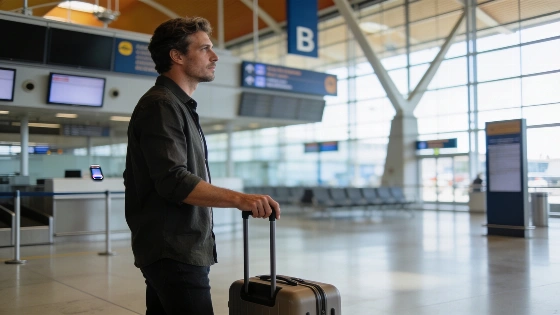
Travel insurance is growing by around 5% a year as war risks, natural disasters and transport failures change what tourists expect. Heymondo forecasts a 40% rise in premiums and says it will insure more than two million travellers this year.
Travel insurance is no longer a small extra for many holidaymakers. Demand has absorbed the shock of war risks, natural disasters and transport disruption. Travellers are also more aware of what an emergency abroad can do to their finances. Heymondo expects its premiums to grow by around 40% this year and says it will insure more than two million travellers.
The company's figures show how quickly the market has grown. Heymondo has insured more than three million travellers since it was founded. Its business grew by almost 70% between 2024 and 2025. Across the wider travel insurance sector, the annual increase is around 5%.
UN Tourism reported about 300 million international tourist trips in the first quarter of 2025, up 5% from a year earlier. The recovery of global travel is expanding the potential customer base for travel insurance.
The wider recovery in tourism is adding to that demand. UN Tourism reported about 300 million international tourist trips in the first quarter of 2025, up 5% from a year earlier. An industry forecast also puts the wider travel insurance market among the fastest-growing parts of on-demand insurance, with a projected CAGR of 18.9% through 2035.
Customers now want more than a standard policy. Ricard Doménech, co-founder and co-CEO of Heymondo, told La Información Económica that travellers are more familiar with the risks attached to international trips. They may accept a higher price within a limited range. In return, they expect more flexible services and broader, deeper cover.
The reason is financial. Heymondo says it has paid claims worth more than one million euros. It regularly handles individual cases valued at 200,000, 300,000 or 400,000 euros. Without insurance, Doménech warns, a serious incident can damage a traveller's assets or even lead to bankruptcy. The company puts the cost of protection at close to 1% of a trip budget. Fewer than 8% of policyholders ultimately report an incident.
The market was tested early in the year. Travel started strongly, but fighting in the Middle East escalated at the end of February. Transport costs rose and demand slowed. The effect was clear during Easter, when the period also brought natural disasters. Summer travel recovered strongly, and the sector regained the ground lost during the second quarter.
Medical claims remain a central reason to buy cover. An industry report citing UNESPA recorded 172,654 travel-insurance incidents in 2025, with 51% linked to illness or hospitalisation. North America accounted for 12% of incidents but 24.3% of payouts, reflecting the high cost of medical care in the region.
Medical costs remain one of the clearest reasons to buy cover. An industry report citing UNESPA recorded 172,654 travel-insurance incidents in 2025. Illness or hospitalisation accounted for 51% of them. North America made up 12% of incidents but 24.3% of payouts, reflecting the high cost of medical care in the region.
This is a different kind of travel pressure from the capacity problems described in an earlier Ceuta report. Insurers are dealing with the cost of disruption before it becomes a personal financial crisis. The fact that fewer than one in twelve customers files a claim does not remove the value of a policy. It explains why travellers pay for protection against events that are unlikely but could cause major losses.
Airline and infrastructure failures are adding to that concern. After a major NATS disruption in the United Kingdom, trade body Airlines UK estimated that more than 330,000 passengers were affected, including people facing cancellations and delays. Events like this are increasing interest in policies that cover travel disruption.
The products on offer are changing too. Industry forecasts put the global market for cancel-for-any-reason, or CFAR, insurance at $2.67 billion in 2025 and $2.98 billion in 2026. That implies an annual growth rate of 11.7%. These policies appeal to travellers who want more freedom than the narrower list of covered reasons in many standard products.
Travellers still need to separate wider disruption cover from ordinary insurance. Consumer guidance from GoCompare says standard travel policies commonly exclude losses directly or indirectly connected with war, armed conflict or civil unrest. Cover for those risks may require a specialised and more expensive product. Add-ons can address selected cancellations or interruptions caused by conflict, natural disasters and transport failures.
Heymondo is approaching its first decade in a strong position, according to Doménech. Ricard Doménech and David Pérez founded the Barcelona insurtech. It now has established positions in Spain, Italy and France. Its expansion plan combines deeper activity in those markets with new launches across Europe. The company entered Romania at the end of last year and maintains a presence in Portugal. It says further markets remain on its roadmap.
The plan has financial backing from the US investment fund JC Flowers. The fund joined the company's capital last year to support growth. Heymondo is also examining possible acquisitions outside Spain when specific assets could add capacity or differentiation. Organic expansion remains its main route forward.
The industry is moving away from the idea of travel insurance as a routine purchase made at the last minute. Customers are comparing the depth of cover with the scale of possible losses. They are willing to pay more when the protection is clear. Heymondo's numbers show a business benefiting from that change, while its European expansion gives the shift a clear commercial direction. For travellers, the practical lesson is simple: a small premium can protect against a claim large enough to threaten personal finances.