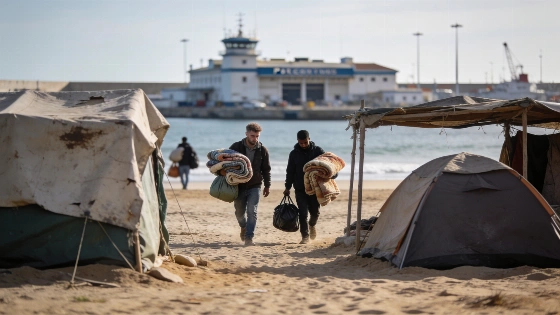
Ceuta’s new port camp was built for 1,700 people, but more than 2,000 migrants were turned away and sent back to the beaches. The city is now asking the European Union for urgent support.
More than 2,000 migrants were sent back to Ceuta’s beaches after the city’s new port camp ran out of room. The facility was designed for 1,700 people. More than 4,000 others remained across the settlements at El Trampolín and Benítez. The failed transfer left Ceuta facing another night of overcrowded streets and makeshift camps. Reuters, AFP and Al Jazeera reported that the temporary reception point filled quickly as people were moved from the beaches.
The operation began early on Friday. Guardia Civil and Policía Nacional units cleared the two coastal sites. Migrants started running during the transfer, and the Unidad de Intervención Policial fired shots into the air to control the crowd. Local authorities said there were no serious incidents.
Before the beach-clearance operation, the Spanish government said that more than 5,300 migrants who had remained in Ceuta after the July arrivals had returned to Morocco during the previous month.
The result was visible on the sand.
Workers had planned to clean the beaches, but they had to suspend the work because the evacuation was incomplete. El Trampolín still contained improvised tents, shacks and a makeshift prayer area. An informal market sold bread, tobacco, biscuits and clothes. People also cooked between the shelters. Reuters and AFP described similar conditions, with migrants living in tents and outdoors while waiting for space in the reception system.
About 1,700 people who found a place spent their first night at the port without notable incidents. It is the largest temporary reception facility opened in Ceuta since the mass arrivals at the end of July. Its capacity, however, was already below the number of people gathered on the beaches. The National reported that Spain’s National Court had authorized temporary accommodation in the port’s industrial area for up to 1,500 adults. That figure shows how far the site’s legal capacity fell short of the number of people needing shelter.
The pressure followed a sharp increase in arrivals from neighbouring Morocco in July 2026. Estimates of the number still in Ceuta differ: Reuters referred to thousands, the Spanish government cited about 10,000, while other reports gave ranges from 5,000 to 10,000 or as many as 13,000 according to Ceuta authorities.
Government sources say roughly 3,000 migrants remain on Ceuta’s streets. That is why the port transfer has not eased the pressure. It moved part of the population, but created no space for everyone else. Reuters, The National and France 24 gave different estimates, depending on the date and the people counted. All of them, however, described a crisis involving thousands of migrants.
Ceuta’s vice-president Kissy Chandiramani called the operation chaotic. She said neither the city government nor the port had received advance notice. The transfer also coincided with children arriving at the school beside El Trampolín, creating another problem in an already crowded area.
Chandiramani wants the return procedures to move faster. She warned that Ceuta could become what she called the “great CETI of North Africa” if people remain in the city without enough space or a faster administrative response. Officials are processing around 100 cases each day. Chandiramani said additional resources could allow the work to finish in 15 days instead of leaving the backlog to grow.
The city is also asking the European Union for support. As earlier reporting showed, the transfer was already under legal and political pressure. The latest scenes show what happens when a port facility lacks both space and coordination.
The issue has also reached Congress. Enrique Santiago, Izquierda Unida’s spokesman, supports stronger border controls but insists that authorities must protect human rights. He said his party would support a future reform of the immigration law to overcome the obstacle identified by the Tribunal Supremo. That obstacle concerns the return of migrants who enter by swimming. Any reform, he said, must comply with those rights.
A citizens’ gathering is scheduled for Saturday outside the Delegación del Gobierno in Ceuta. Its slogan is “Por los derechos de los niños de Ceuta”, and its call is “Ceuta es España”. The event will bring a public demonstration to a crisis already involving police operations, administrative delays and pressure on reception capacity.
The numbers leave little room for cosmetic fixes. A camp for 1,700 people cannot absorb more than 4,000. Moving only those who fit sends the remaining pressure back to the beaches and streets. Ceuta needs faster case processing and advance coordination between authorities. It also needs European assistance if it is to manage the current numbers without repeating the same cycle. The operation did not solve the problem. It transferred only part of the population and exposed the city’s lack of capacity.