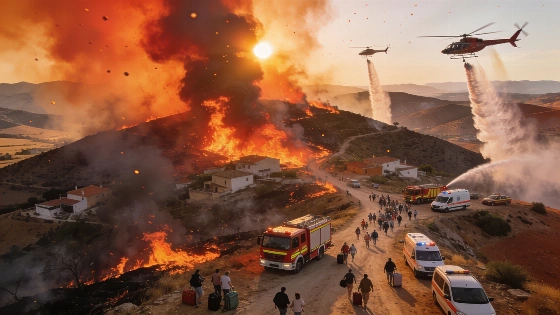
A fast-moving wildfire in Los Gallardos, Almería, has claimed at least 12 lives, making it the deadliest on record in Andalusia. Most victims were foreign tourists caught outside evacuation routes. Authorities continue searching for 19 missing.
At least 12 people have died in a devastating wildfire that swept through Los Gallardos (Almería) on Thursday, marking the deadliest forest fire ever recorded in Andalusia. The rapid advance of the flames, combined with the region’s rugged terrain and scattered homes, left little time for escape. According to the Junta de Andalucía, the victims—believed to be foreign tourists—were overtaken by fire after attempting to flee along a route not designated for evacuation.
The provisional death toll already surpasses any previous wildfire tragedy in the region. For comparison, the deadliest fire in Spain remains the 1979 Lloret de Mar disaster in Girona, which claimed 21 lives, followed by the 1984 La Gomera fire with 20 fatalities. The Los Gallardos incident now stands out for both its speed and the number of casualties, with authorities still searching for 19 people who remain unaccounted for.
Emergency services have faced enormous challenges due to the area’s difficult topography. The fire perimeter is estimated at over 3,150 hectares, with deep ravines and inaccessible slopes hampering ground operations. Efforts have focused on the fire’s head and right flank, while the left remains largely unreachable, though a nearby motorway may serve as a natural firebreak.
Evacuations have been extensive. The entire municipality of Bédar, its main urban center, isolated homes, and seven outlying districts—including Almocáizar, El Chocolate, Los Collados, Fuente del Albarico, Los Pinos, and La Serena—were cleared as a precaution. The Miraflores tourist complex was also evacuated. In neighboring Antas, around 80 residents were moved to safety overnight as flames approached.
Local officials have described a tense night as the fire entered Bédar around 2 a.m. While the immediate threat there is now under control, shifting winds remain a concern. The mayor of Bédar, Pedro Ridao, highlighted the crucial support from the Unidad Militar de Emergencias (UME) and aerial resources, expressing hope that the combined response will contain the blaze.
Authorities have set up a special office in Garrucha for families of the missing, where DNA samples are being collected to speed up victim identification. The Andalusian Emergency Agency and 112 have also launched a dedicated helpline (677 904 624) to provide psychological support and up-to-date information to relatives, coordinated by the Psychological Intervention Group in Emergencies and Disasters (GIPED).
National leaders have responded to the tragedy. The King and Queen expressed deep sorrow for the victims and gratitude to emergency workers, while Prime Minister Pedro Sánchez conveyed condolences and urged caution for those near the affected areas. Defense Minister Margarita Robles noted that 200 UME personnel and 70 vehicles are deployed on site, emphasizing the importance of following evacuation instructions.
Initial investigations suggest the fire may have started after a power line pole collapsed, raising questions about infrastructure maintenance and potential liability. The president of the Junta de Andalucía, Juan Manuel Moreno, indicated that this aspect will be examined as part of the ongoing inquiry.
This incident follows a series of severe wildfires across Spain in recent years, highlighting the growing risks posed by extreme weather and challenging landscapes. In a related context, emergency responses to natural disasters have become increasingly complex, as seen when Barcelona authorities evacuated several buildings after a major sinkhole—demonstrating the strain on local resources during multiple crises.
Spain’s wildfire season has grown longer and more intense, with authorities urging residents and visitors to heed official guidance during emergencies. The Los Gallardos tragedy underscores the critical importance of following established evacuation routes and the need for robust coordination among emergency services, especially in areas popular with tourists and those with difficult terrain.