Spanish police seized nearly €1 million in cash from two brothers in La Rioja. The suspects allegedly used their companies to import cocaine for an Albanian network based in Dubai. Authorities made 44 arrests across Spain and Ecuador.
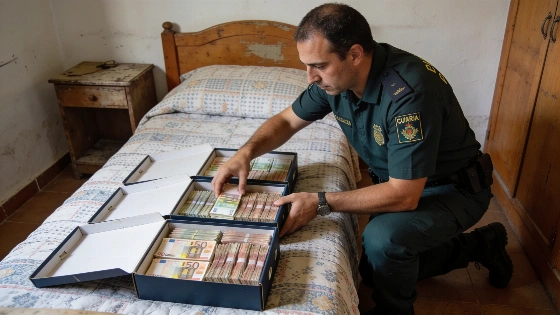
Spanish authorities have dismantled a key part of an international cocaine trafficking network after arresting two brothers in Arnedo, La Rioja. During a search of one suspect’s home, officers from the Unidad Central Operativa (UCO) of the Guardia Civil discovered almost €1 million in cash, packed into three shoeboxes and hidden under a bed. The brothers, both business owners, are accused of using their companies to facilitate the entry of large cocaine shipments into Europe on behalf of an Albanian-led organization operating from Dubai.
Investigators say the suspects managed a dozen companies involved in road transport, fruit and vegetable imports, and wholesale cosmetics. These businesses allegedly served as fronts to justify the import of goods—such as bananas, pineapples, onions, wood, and scrap metal—through Spanish ports in Málaga, Valencia, and Algeciras. The cocaine, mainly shipped from Guayaquil in Ecuador, was concealed within these legitimate cargoes. The UCO believes the brothers’ companies also played a role in laundering the proceeds from drug sales.
Between August 2023 and November 2024, authorities intercepted seven major cocaine shipments in Ecuador, Brazil, and Spain, totaling over 21 tonnes. The operation, codenamed Mondragón, led to 44 arrests: eight in Spain and 36 in Ecuador. The younger brother, identified as the group’s leader, was detained in January 2025 after a seizure in Valencia and has remained in custody since. The second brother was arrested in July 2025, the same day police found the hidden cash. Both men reportedly maintained a high standard of living while avoiding conspicuous displays of wealth.
Alongside the brothers, six other suspects of Spanish and Moroccan nationality were detained for their alleged involvement. Police also carried out searches in Alicante, Seville, and Cádiz, freezing properties, vehicles, and financial assets linked to the network. In Ecuador, local police with support from the Guardia Civil conducted 38 arrests and around 50 searches in March 2025, targeting the logistics side of the operation. The Albanian investors based in Dubai are believed to have financed the cocaine purchases and injected large sums into the Spanish companies, helping to disguise the true nature of the shipments and payments.
This case highlights the growing complexity of international drug trafficking, where criminal groups exploit legitimate trade channels and global financial flows. Spanish authorities have intensified cooperation with counterparts in Latin America and the Middle East to disrupt these networks. The use of commercial companies as a cover for smuggling and money laundering is a recurring challenge, as seen in other recent cases. For example, the impact of organized crime on public services and security was also discussed in a recent report on emergency care in Madrid, which can be found here. The ongoing investigation into the La Rioja network underscores the need for vigilance in monitoring cross-border business activities and financial transactions.
Spain remains a major entry point for South American cocaine into Europe, due to its extensive port infrastructure and trade links. Law enforcement agencies continue to adapt their strategies to counter increasingly sophisticated smuggling methods and the use of shell companies. The outcome of the Mondragón operation is expected to have a significant impact on the supply routes and financial structures used by international drug cartels operating in the region.