Spanish Solar Parks Now Host More Birds Than Neighboring Fields. Recent data from Spain shows that solar power plants now support a greater variety of bird species than surrounding farmlands. The reason: a shift away from chemicals and a new approach to land management.
In Minglanilla, Revilla Vallejera, and Trujillo, an unexpected result was recorded: the territories of solar power plants were found to host more bird species than the neighboring agricultural fields. This conclusion was reached by experts from UNEF and the independent environmental company EMAT, who analyzed data from 2025.
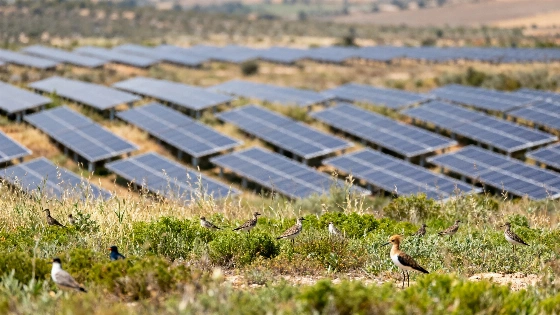
The reason for these changes is not the panels themselves, but rather the changing approach to land use. Most modern solar parks are built on former intensive farmland where the soil is depleted and chemicals and constant tilling create a poor environment for wildlife. After the panels are installed, pesticides and herbicides are no longer used, hunting is banned, and maintenance is limited to occasional staff visits and natural sheep grazing. As a result, the ecosystem begins to recover.
More species and rare birds
In Minglanilla, 32 bird species were counted inside the solar park, compared to 19 in the surrounding fields. In Revilla Vallejera, 39 versus 34, and in Trujillo, 31 versus 25. Importantly, it's not only common sparrows and larks: under the panels, both rare and endangered species can be found—such as the stone-curlew, great bustard, short-toed lark, owl, and red-footed falcon. As plant life recovers, insects appear, followed by new birds and even predators: eagles, kites, falcons, and owls.
“Conservoltaics”: energy and nature
Environmentalists call this approach “conservoltaics” — a combination of clean energy production and active nature restoration. In Spain, this trend is just gaining momentum, but similar results have already been seen in the UK and Australia. For example, British scientists found that solar parks with properly managed vegetation host nearly three times more birds than neighboring fields. In Australia, it was discovered that sheep grazing under solar panels produce higher quality wool thanks to a unique microclimate.
What matters for the ecosystem
However, not every solar park automatically becomes a haven for nature. If grass is mown down to the roots and diversity is not encouraged, the ecosystem does not recover. Key measures are preserving natural vegetation, using local plant species, creating ecological corridors, and grazing sheep instead of using machinery. This approach supports biodiversity and turns an energy facility into a refuge for birds and insects.
Attitudes toward solar energy are changing
Research findings are changing perceptions of solar power plants: now the discussion is not only about their impact on the landscape, but also how they can support nature. The question is no longer whether panels occupy farmland, but what happens to these areas after the switch to a new regime. As UNEF notes, the industry has developed a special Sello de Excelencia that confirms a high standard of environmental management.
Interestingly, similar effects are observed in other fields as well: for example, an American student developed a system for converting plastic into fuel, which could also change the approach to resource use (more about the project).
Overall, Spain's experience shows that effective management of solar parks can not only generate energy but also restore ecosystems, provided aggressive chemicals are avoided and nature is given time to recover.