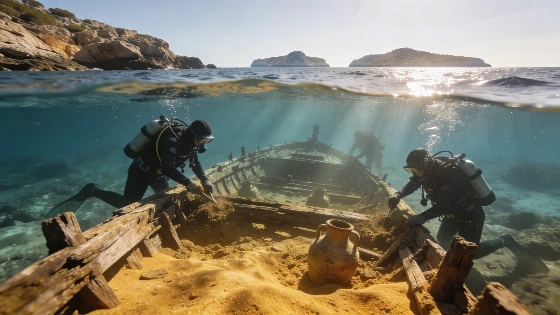
Roman Ship Illes Formigues II to Receive BCIN Status in Catalonia for the First Time. Catalan authorities have initiated the process to designate the Roman ship Illes Formigues II as an asset of national significance. This is the first such case in the region. The vessel was discovered at a depth of 46 meters off the Costa Brava coast.
For the first time in Catalonia, an underwater archaeological site will receive the highest level of protection: the Roman ship Illes Formigues II, which sank more than two thousand years ago off the Costa Brava, has been officially recognized as an object of national cultural heritage (BCIN). The status recognition process has already begun, and regional authorities expect it to be completed soon.
The vessel, about 20 meters long, was carrying hundreds of amphorae filled with salted fish and fish sauce from Baetica (present-day Andalusia) to southern Gaul. According to experts, the wreck may have been caused by a collision with one of the small islands in the Illes Formigues archipelago, located between Palafrugell and Palamós. The ship lies at a depth of 46 meters, which protected it from looting for a long time and made excavations difficult.
A rare find at depth
The possible location of the ship was first reported in 2010, when a diver alerted specialists from the Catalonia Center for Underwater Archaeology (CASC) after discovering it. Only in 2016, with the help of the deep-sea submersible Ictineu3, were archaeologists able to confirm the uniqueness of the site: Illes Formigues II turned out to be the best-preserved Roman ship in the region, and its cargo—amphorae of Dressel types 7, 10, and 12—remained intact. These contained salted mackerel and fish sauce, allowing researchers to study the trade in products from Baetica around the Mediterranean in the 1st century BC.
According to CASC director Ruth Geli, for the first time in Catalonia, researchers have managed to study an ancient ship that preserved not only its wooden hull but also its contents. The depth at which the vessel is located has served as a natural protection against looting, but working here is also challenging for archaeologists: each 25-minute descent requires an equal amount of decompression time. After each excavation phase, the site is carefully covered to protect it from natural factors and possible intrusions.
A new level of protection
In 2024, CASC, together with the Archaeology Service, began preparing documents to assign Illes Formigues II the status of BCIN in the category of archaeological zone. This is the first time in Catalonia that an underwater site has received such a high level of protection. In recent years, specialists have not recorded any attempts at looting, which they attribute to growing public attention to the preservation of underwater heritage.
In June 2025, the Illes Formigues II research project was acknowledged by UNESCO as an example of best practices in underwater cultural heritage for the period 2026–2029. The project will involve a multidisciplinary team: underwater archaeologists, shipbuilding specialists, ichthyologists, ceramists, palynologists, restorers, and operators. They will study not only the ship's hull but also its cargo and crew belongings.
Context and significance
The Catalan registry of underwater archaeological sites lists 876 monuments, most of which are sunken vessels. At the national level, only two sites have similar status: Phoenician and Roman ships in the Bay of Mazarrón (Murcia) and the Roman merchant ship Bou Ferrer off the coast of Alicante. For comparison, in other regions of Spain, the protection of underwater heritage also sparks debate: for example, recent initiatives to reform fishing and hunting regulations in Madrid drew strong reactions from environmentalists, as noted in the article on the criticism of Madrid's fishing and hunting reform.
In June 2025, the General Directorate of Cultural Heritage of Catalonia supported the initiation of the procedure to grant BCIN status to Illes Formigues II. In March 2026, Minister of Culture Sonia Hernández officially launched the process. After the public consultation is concluded, a final decision is expected to be approved at a meeting of the Catalan government.