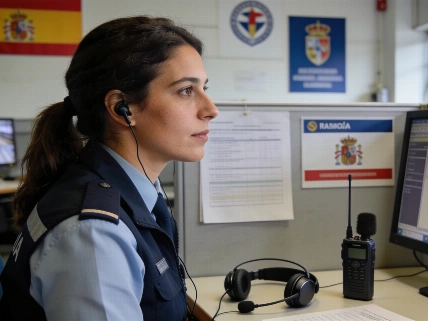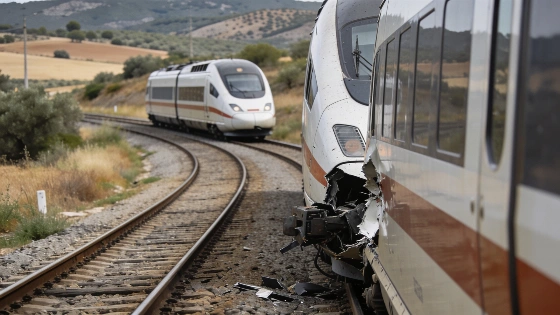
The AVE driver had reported a partial transmission failure before the train struck the stationary Iryo near Urda in Toledo. The recordings suggest Atocha’s control operator then gave an instruction that experts say did not fit the situation.
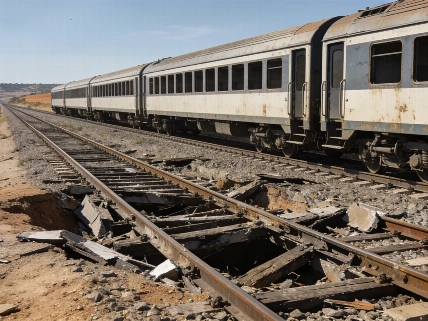
The collision occurred at about 8:53 a.m. on 28 October, on track 2 near kilometre point 118+800 at the entrance to Urda station. Early reporting estimated that the AVE hit the stopped Iryo at between 160 and 200 kilometres per hour. The speed remains subject to technical examination.
The operator appears to consult a document and check the instruction with colleagues. Information from experts consulted by EL PAÍS, the AVE should have received LZB3, requiring it to continue under the backup BSL system at a speed that allowed the driver to stop for any visible obstacle. Here, that meant a maximum of 40 kilometres per hour.
Instead, the operator issued LZB4. That procedure calls for disconnecting and reconnecting LZB, then continuing under BSL subject to the control centre’s instructions. Because another train occupied the block, experts say the AVE should still have been told to proceed at sight. The instruction it received allowed normal running at the section’s maximum authorised speed.
The audio points to more than a single mistaken instruction. Experts cited in the report say the controller’s uncertainty indicates a training shortfall. They also identify the absence of a final control that could have blocked an incorrect order while the line remained occupied.
Spain’s accident-investigation authority, AITAT, opened a technical investigation on 29 October after classifying the collision as a grave accident. The investigation is intended to establish causes and contributing factors, not criminal or civil liability. AITAT said all hypotheses remained open and cautioned against drawing conclusions beyond established facts.
Investigators went to Adif’s Atocha control centre to collect audio recordings and operational data, as well as the “moviola”, a replay of signalling and train movements. They are examining the material alongside train and infrastructure data to reconstruct the sequence of communications and authorisations, including any system failures. EFE reported that the Guardia Civil also questioned the control-room operator on duty; that interview does not itself establish individual responsibility. The technical investigation was expected to last at least a year.
LZB sends continuous messages from equipment along the Madrid-Seville line to the train. A reception failure lasting more than six seconds triggers a transmission failure. The system supervises speed and sends driving instructions to the cab, including a target distance and a speed limit. A separate target speed guides gradual braking.
When LZB fails, BSL provides a fallback based on conventional trackside signals. ASFA monitors those signals and triggers emergency braking if a train passes a signal requiring it to stop. A total block failure means there is no traffic between the stopped train and the next stop signal; a partial failure means another train is in that section.
Stopping on a railway line is routine and, experts say, does not in itself create a risk. The control centre is meant to show occupied blocks in red. Transport Minister Óscar Puente said that indication remained visible, so staff at Atocha should have known the Iryo was stopped ahead of the AVE.
The driver repeated Atocha’s instructions as required. When told to resume normal running, he queried the order before acknowledging it. The recordings are also part of another strand of the inquiry, covered in the report on black-box custody.
Spain’s Madrid-Seville high-speed line uses the German-origin LZB system, introduced in the 1990s. The minister has said communication problems occur and can require the use of backup systems; drivers consulted by the newspaper say the Urda-area failure was not the first, though they reject treating such failures as trivial. LZB is also used on the Móstoles-Humanes commuter line.
Newer ETCS technology continuously supervises speed and braking, while handling radio communication. It operates on several Spanish routes, including Madrid-Barcelona. The system was basic to the investigation of the 2013 Angrois crash, in which 80 people died: ADIF had authorised its disconnection before the Alvia derailed, citing faults and delays.