Uzbekistan has transformed two million hectares of the Aral Sea’s barren seabed into a living barrier of desert shrubs. This urgent intervention aims to halt toxic dust storms and stabilize the region’s devastated landscape, but the lost waters will not return.
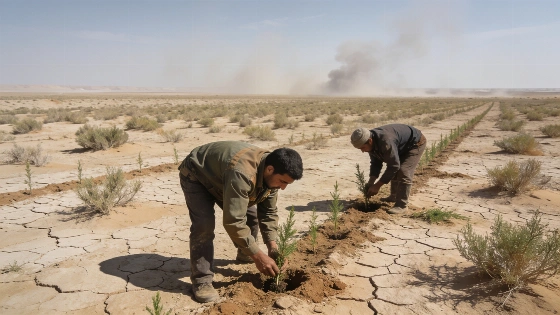
Two million hectares of the former Aral Sea floor are now covered with a thin but stubborn layer of saxaul and other desert plants. Just a decade ago, this scale of intervention would have seemed impossible. Uzbekistan’s campaign, confirmed by the State Forestry Agency in March 2026, has already surpassed its own targets and now far exceeds the 1.7 million hectares reported in late 2023.
This is not restoration. It is damage control. The Aral Sea, once the world’s fourth largest inland lake, began to vanish in the 1960s after the Soviet Union diverted the Amu Daria and Sir Daria rivers to irrigate cotton fields. The result: 90% of the water disappeared, fisheries collapsed, and the Aralkum desert—60,000 square kilometers of exposed, salty seabed—took its place.
In neighboring Kazakhstan, about 1.2 million hectares of the former Aral seabed have also been covered with vegetation, highlighting the regional scale of efforts to combat toxic dust storms.
The legacy is toxic. Decades of heavy agriculture left not just salt, but chemical residues. Winds now lift contaminated dust and carry it across fields, villages, and even distant cities. The health and economic toll is severe: the World Bank estimates annual losses of $44.2 million in Karakalpakstan alone, the region hit hardest by the disaster.
Uzbekistan’s response has been large and systematic. Since 2018, more than 7,800 tonnes of desert seeds have been sown, with over 2,000 workers planting and monitoring the new growth. The mainstay is the saxaul, a tough shrub from the Haloxylon genus. Its roots can reach 15 meters deep, and a mature plant can anchor up to four tonnes of shifting sand. These aren’t forests, but low thickets meant to slow the wind and hold down poisoned soil.
Survival rates are low. The Aralkum’s high salinity, harsh winds, and wild temperature swings—from minus 30 to plus 45 degrees Celsius—mean only about 30% of seedlings survive their first year, according to World Bank data. To improve the odds, the UN Development Programme has tested treatments with clay, manure, and water-retaining polymers, borrowing from simple irrigation methods that make the most of every drop of moisture.
Recent reports from 2026 highlight that, alongside saxaul, Uzbekistan has expanded plantings of tamarix and introduced over 40 salt-tolerant species in collaboration with the International Innovation Center for the Aral Sea Region. This diversification aims to increase the resilience of new vegetation against the harsh, saline conditions of the exposed seabed.
It’s worth noting the difference between the national campaign and the more targeted Green Aral project, which has planted over 915,000 individual shrubs since 2020 with the UNDP. The two million hectare figure refers to total area treated, not the number of plants or how dense the cover is. These are not traditional forests, but green barriers built to stop dust at its source.
International support has played a key role. The World Bank’s RESILAND Uzbekistan program has provided $153 million to stabilize degraded land and reduce dust storms. The environmental benefits from these plantings could bring back nearly $39 million a year, but no one expects the Aral Sea to return. The water is gone, along with the livelihoods and ecosystems that once depended on it.
What Uzbekistan has done is a kind of triage—a practical response to a disaster that can’t be reversed. The new saxaul thickets won’t bring back the lake, but they may buy time for the people and land that remain. As the dust settles, the lesson is hard to ignore: some environmental wounds can only be managed, not healed. The fate of the Aral Sea is a warning of what happens when short-term economic goals ignore nature’s limits.